
See exactly how Instant Review evaluates a scan
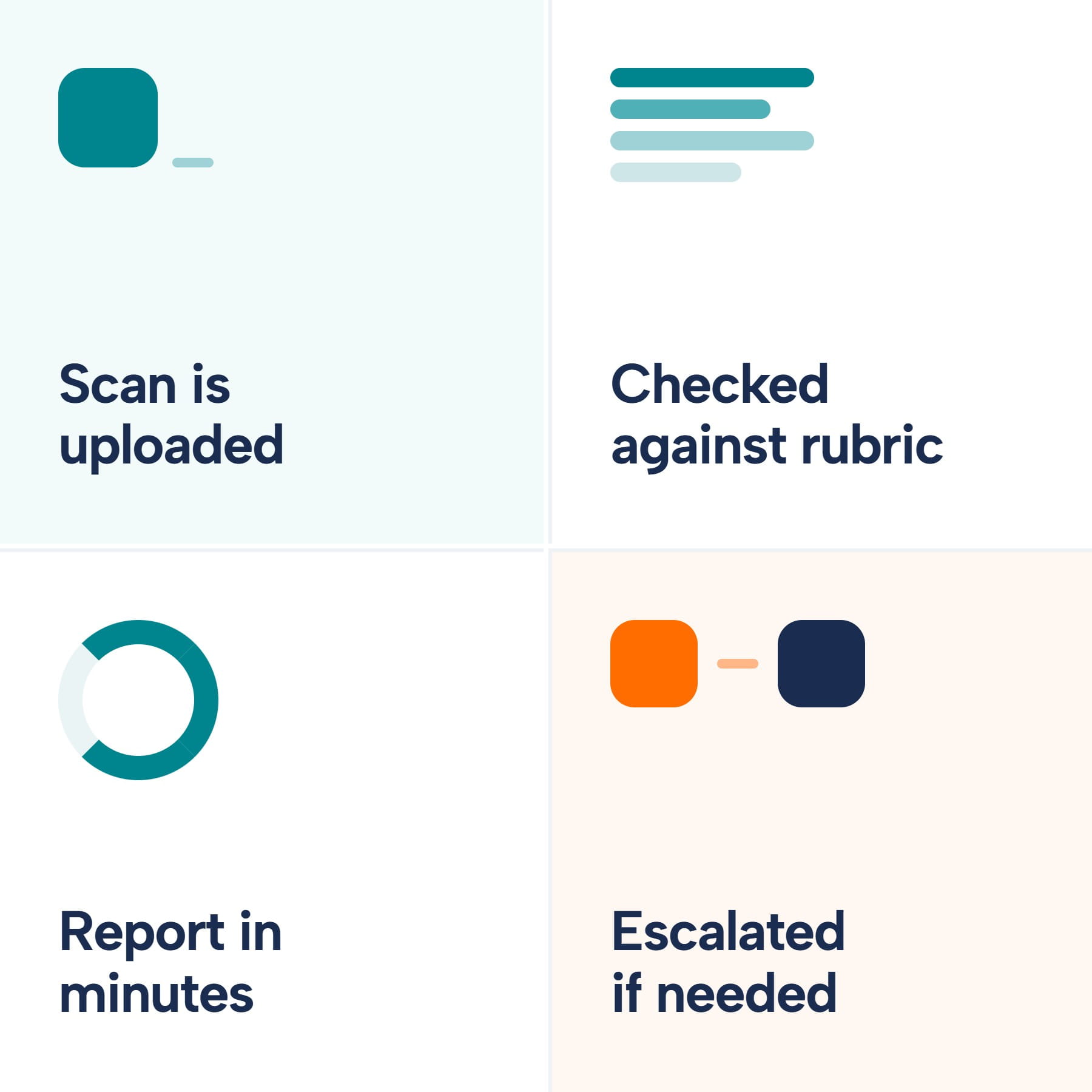
The pipeline: upload, evaluate, report
Instant Review is built around a simple idea: feedback is only useful when it arrives while the scan is still fresh. To make that possible, the entire pipeline is automated and always on. A clinician does not schedule a review, wait for a supervisor to find a free hour, or lose the context of what they were trying to capture. They upload, and within minutes they have a structured report in hand.
What It Evaluates

Image quality

Completeness

Probe technique

Anatomical visualization
Anatomy of a report
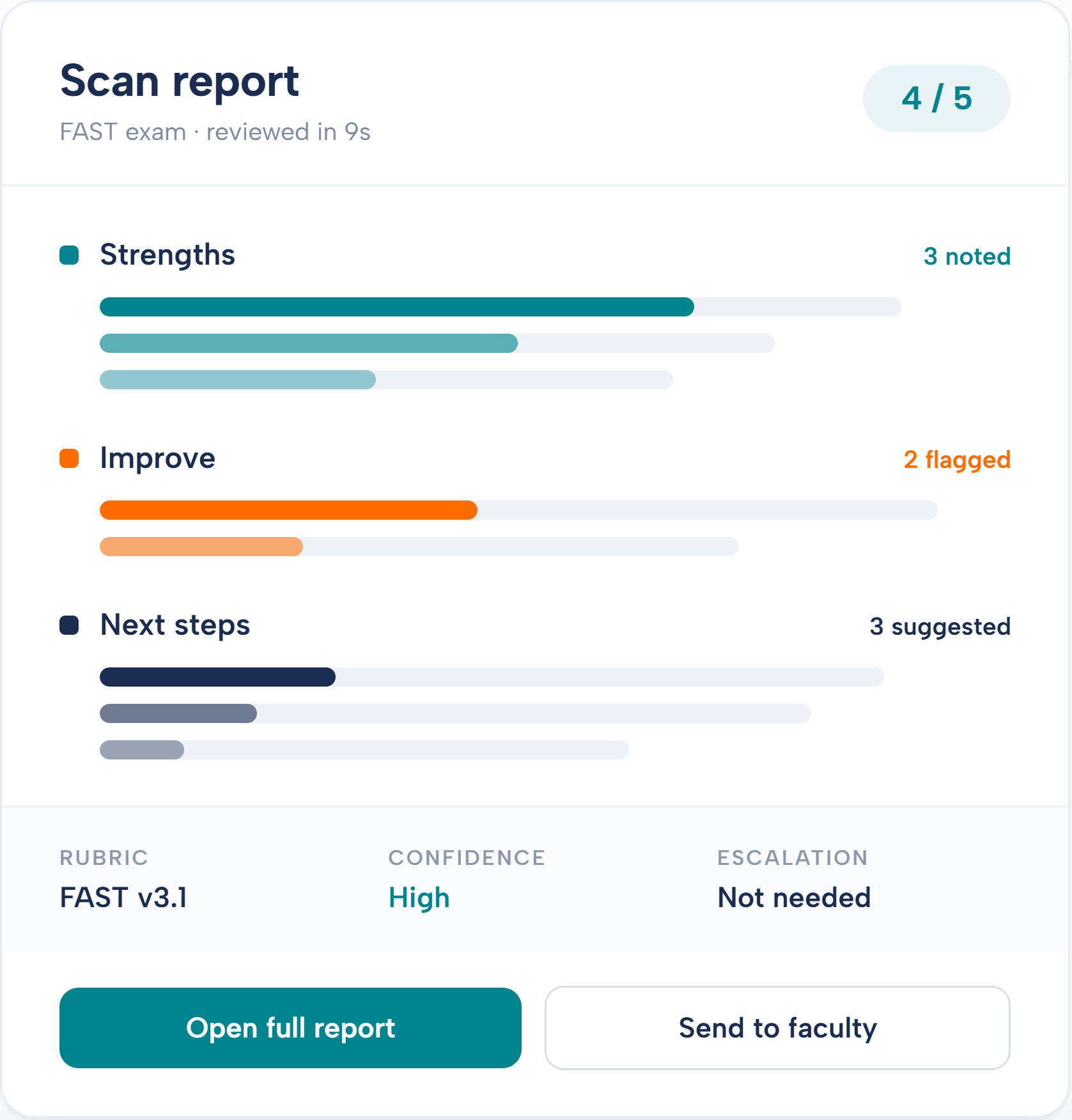
Every report follows the same predictable structure so learners and educators know exactly where to look. It opens with a short summary of the study and an overall read on quality. It then breaks feedback into three parts: strengths, which reinforce what the clinician should keep doing; areas for improvement, which are specific and never generic; and next steps, a short list of concrete actions for the next scan.
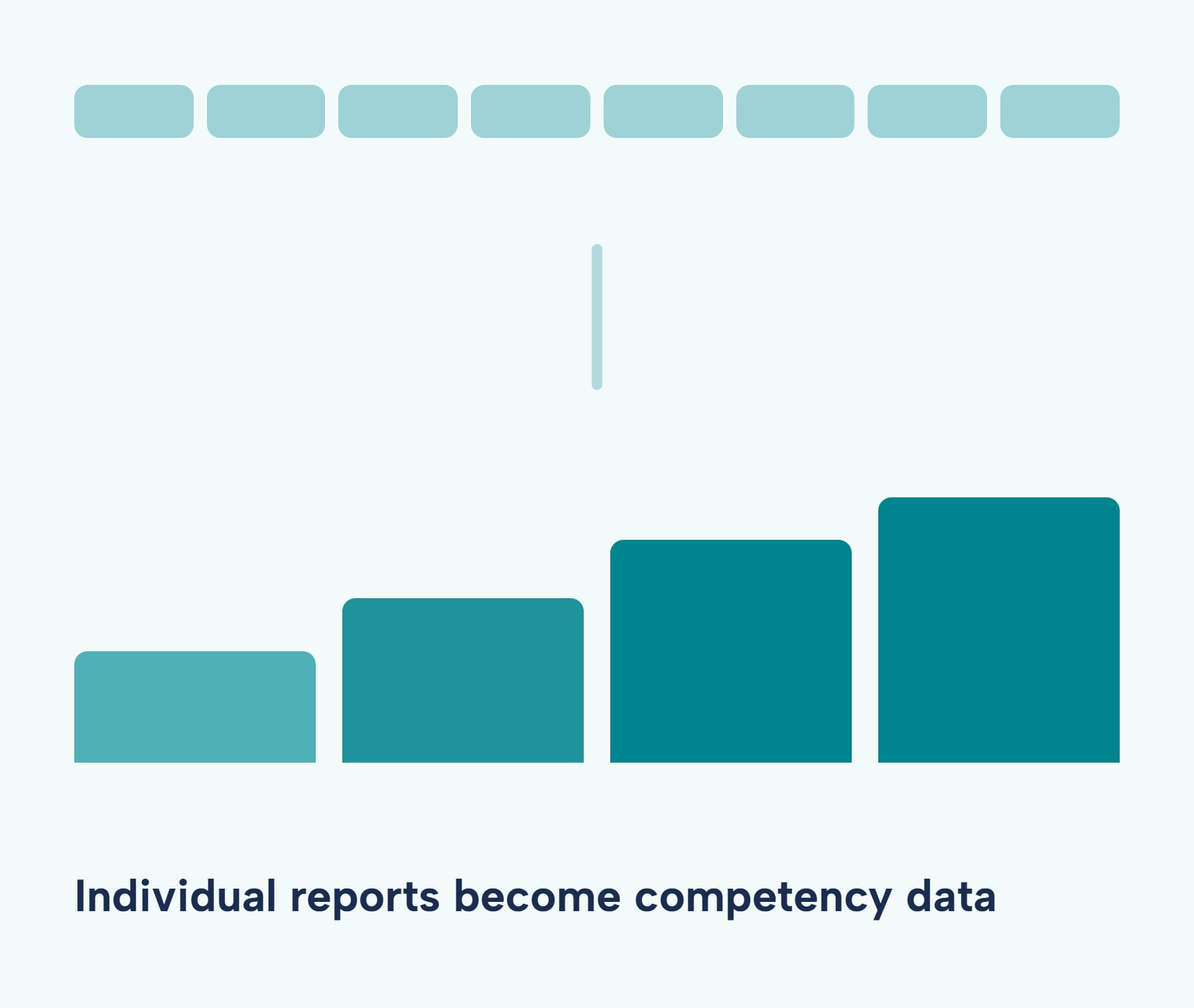
Because the structure is consistent, the report doubles as a teaching artifact. A faculty member can skim it in seconds to confirm the AI’s read, a learner can track the same categories across dozens of scans, and a program can roll the categories up into competency data over time. Consistency is what turns one-off feedback into a curriculum.
The language is deliberately educational. Instead of a bare pass or fail, the report explains why a view fell short and how to fix it — the difference between a grade and a lesson. That is the entire point of an education-first design.
Sample report structure
Turnaround and access
Instant Review is available around the clock. A resident scanning at 2 a.m., a rural clinician on a weekend, or a fellow catching up between clinics all get the same fast, structured feedback — no reviewer availability required. Feedback typically returns in under five minutes, which is the entire reason the tool changes behavior: the guidance lands while the muscle memory of the scan is still intact.
Because everything runs through ScanHub, access scales without a throughput ceiling. Reviewing one scan and reviewing ten thousand scans cost the program the same amount of human time. That is what makes real quality assurance possible across an entire team rather than a lucky few who happen to catch a supervisor at a good moment.
What it does not do
Instant Review is a learning and quality-assurance tool, not a diagnostic device. It does not make clinical calls, it does not replace a qualified reader, and it does not tell anyone how to treat a patient. Its transparency is a feature: learners build real skill instead of a false sense of clinical accuracy, and programs get an assistant that augments their educators rather than pretending to be one. To understand exactly where the boundaries sit, read the education-first and safety page.
Designed to be trusted, not just fast
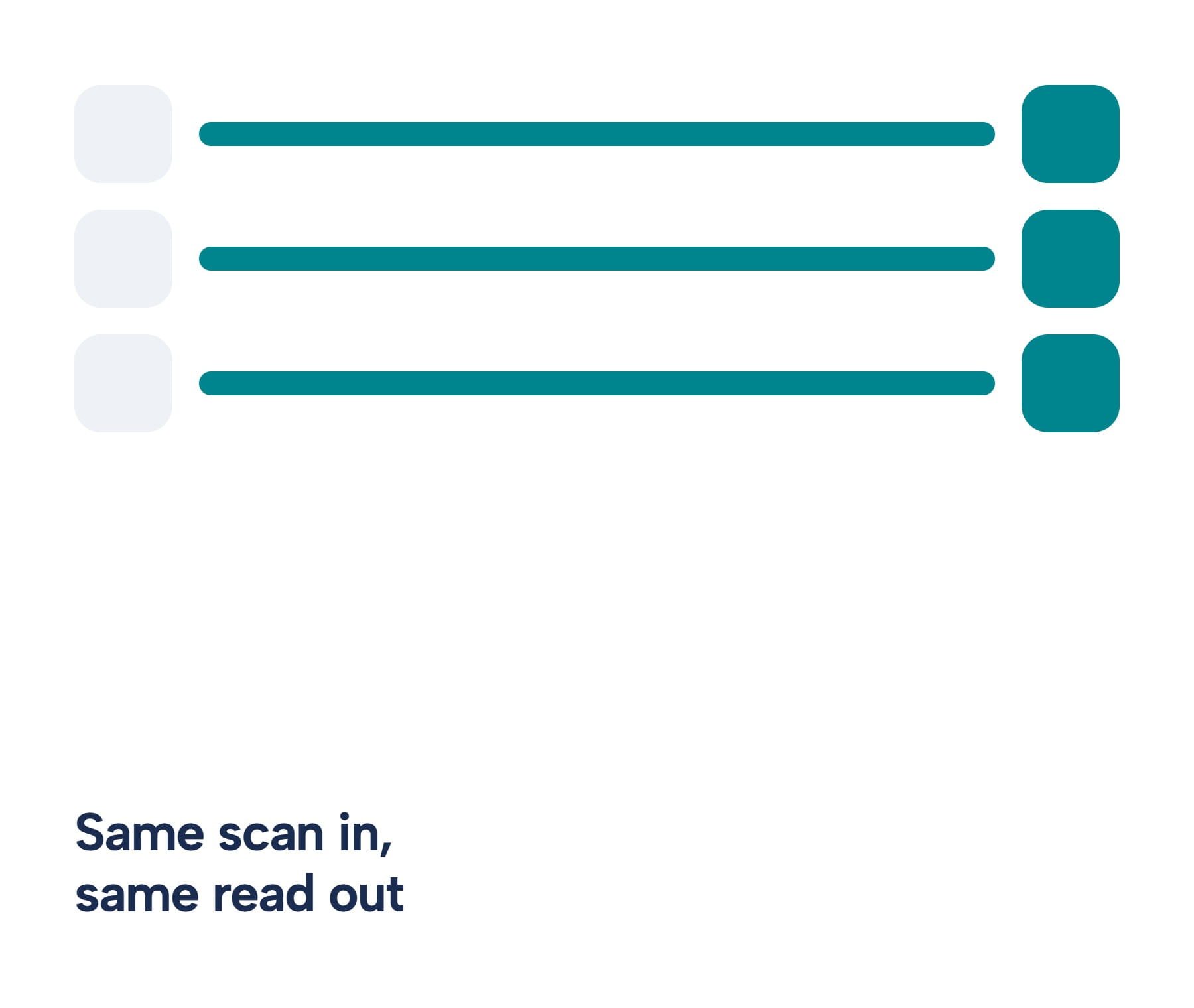
Speed alone would not be worth much if the feedback were arbitrary. What makes Instant Review usable in a program is that the same scan produces the same considered read every time, in a structure everyone recognizes. That predictability is deliberate: it lets a learner compare today’s report to last week’s, lets a faculty member confirm the AI’s read in seconds, and lets a program roll individual reports up into competency data without translating between a dozen reviewers’ private styles.
The pipeline is also built to stay honest over time. Because the evaluation is anchored to explicit rubrics rather than a mood, it can be audited, calibrated against reference exams, and monitored for drift — the checks described on the quality-assurance and scoring pages. The result is an automated reviewer a program can actually rely on, not a clever demo that behaves differently on Tuesday than it did on Monday.
And when a scan genuinely needs a human, the pipeline routes it to one. Fast by default, escalated when it matters — that is the whole design in a sentence.
Why “in minutes” is the whole point
It is worth dwelling on why speed is not a vanity metric here. Learning is a loop — attempt, feedback, adjustment, next attempt — and the value of each rep depends on how tightly that loop closes. Feedback that arrives days later lands after the learner has already moved on, disconnected from the muscle memory of the scan, and so it teaches far less than the same words delivered while the probe is still warm. Compressing the loop from days to minutes is not a convenience; it changes how much a clinician learns from every single scan.
That is the mechanism behind everything else on this page. The pipeline is automated and always on not to impress, but because a review that requires scheduling a human cannot close the loop fast enough to change behavior. Minutes is the threshold at which feedback becomes teaching.
Didn’t find your answer?
No worries! If you have any other questions or need more information, feel free to reach out directly.
Have more questions? Send us a message.
Frequently Asked Questions
What happens after I upload an ultrasound scan?
Once a scan is uploaded through GUSI ScanHub™, Instant Review™ automatically evaluates the acquisition and generates a structured feedback report. The review looks at image quality, completeness, probe technique, and anatomical visualization, then identifies strengths, areas for improvement, and specific actions to apply to the next scan. Feedback typically returns in under five minutes.
What exactly does Instant Review evaluate in each scan?
Instant Review evaluates four core dimensions of ultrasound acquisition: image quality, completeness of the required views, probe technique, and anatomical visualization. The evaluation is structured around explicit criteria and established medical-society guidance rather than a general or open-ended AI interpretation.
What happens if a scan cannot be confidently evaluated by the AI?
Instant Review is designed with human oversight in mind. When a scan falls outside the system’s confidence thresholds or requires additional review, it can be escalated rather than forcing an automated conclusion. The goal is fast automated feedback when appropriate while preserving human review when it matters.