
Quality assurance for POCUS across your health system
Global Ultrasound Institute proudly works with top universities, institutions and medical facilities across the United States and around the world
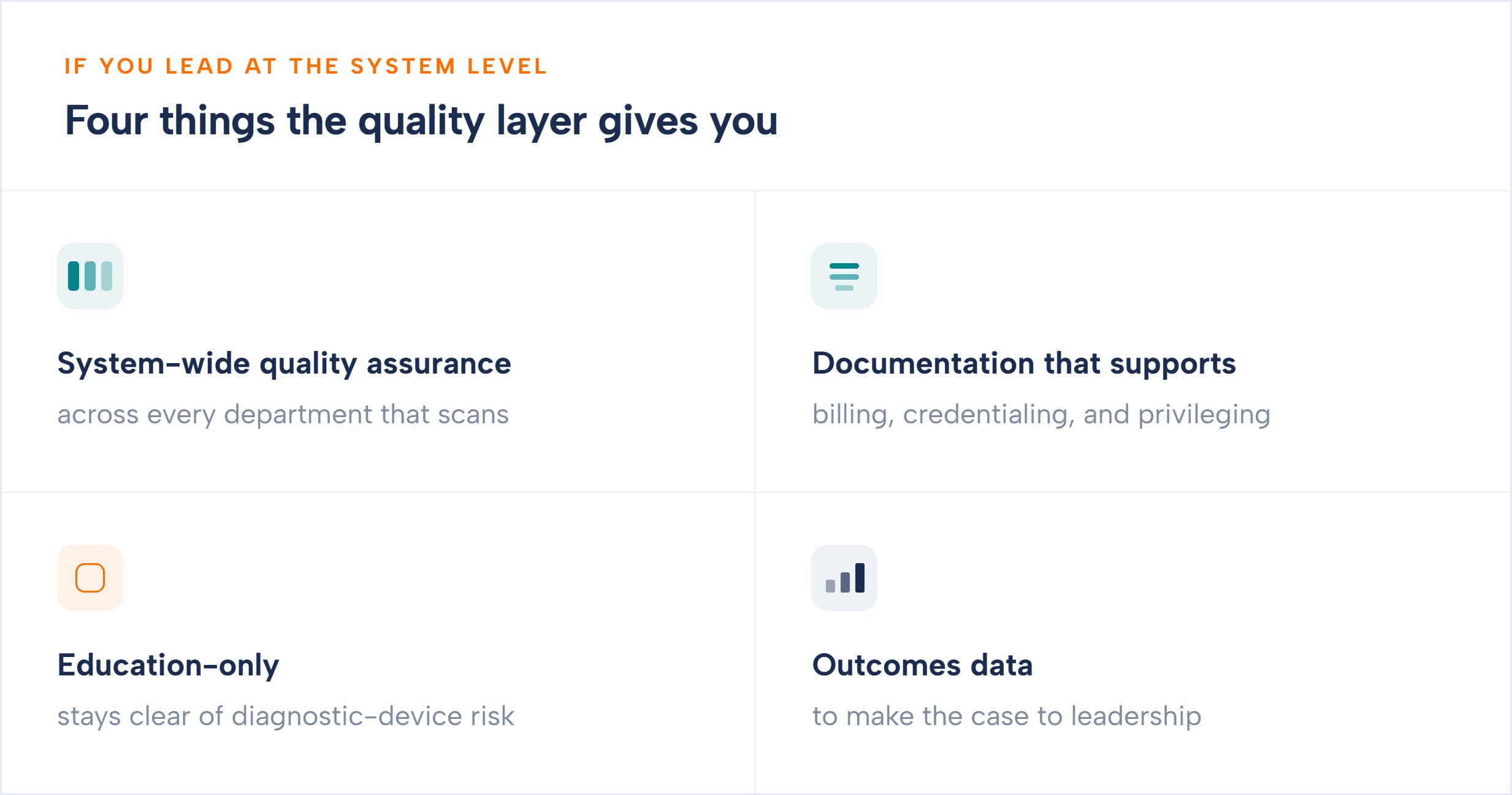
If you lead at the system level
System-wide quality assurance across every department that scans
Documentation that supports billing, credentialing, and privileging
Education-only — stays clear of diagnostic-device risk
Outcomes data to make the case to leadership
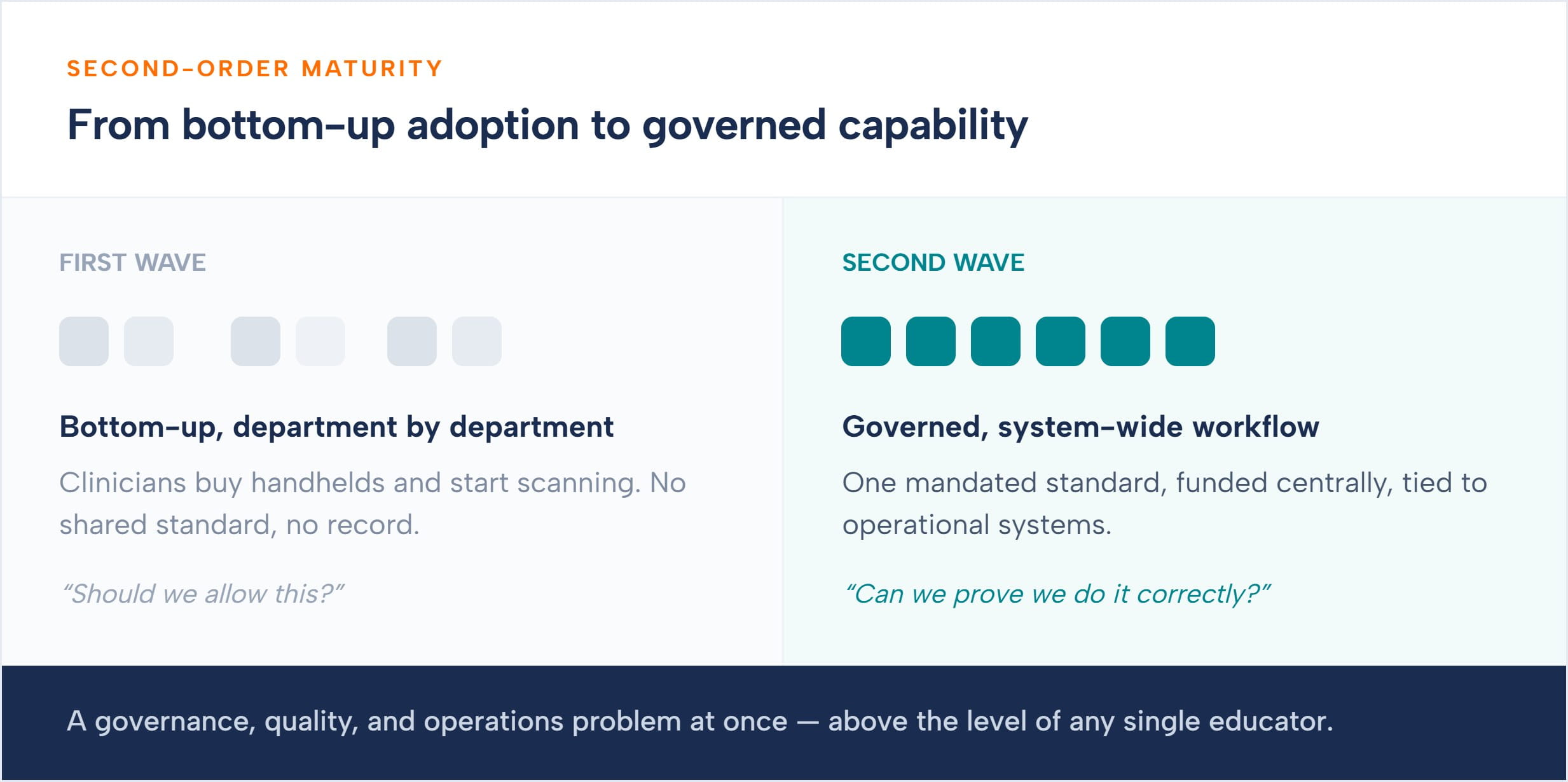
The second-order maturity of POCUS
The first wave of point-of-care ultrasound in a health system is bottom-up: individual clinicians discover it, buy handhelds, and start scanning. The second wave is where administrators come in. Once POCUS is genuinely in use across departments, the questions change from “should we allow this?” to “are we doing it correctly, are we capturing its value, and can we prove both?” That is a governance problem, a quality problem, and an operations problem at once — and it sits above the level of any single educator.
Administrators hold the authority that educators do not: the ability to mandate a standard across departments, to fund it, and to tie it to the operational systems that make POCUS sustainable. Instant Review is built to support exactly that transition — from ad-hoc, department-by-department scanning to a governed, system-wide workflow with quality assurance baked in.
Capturing the value of POCUS
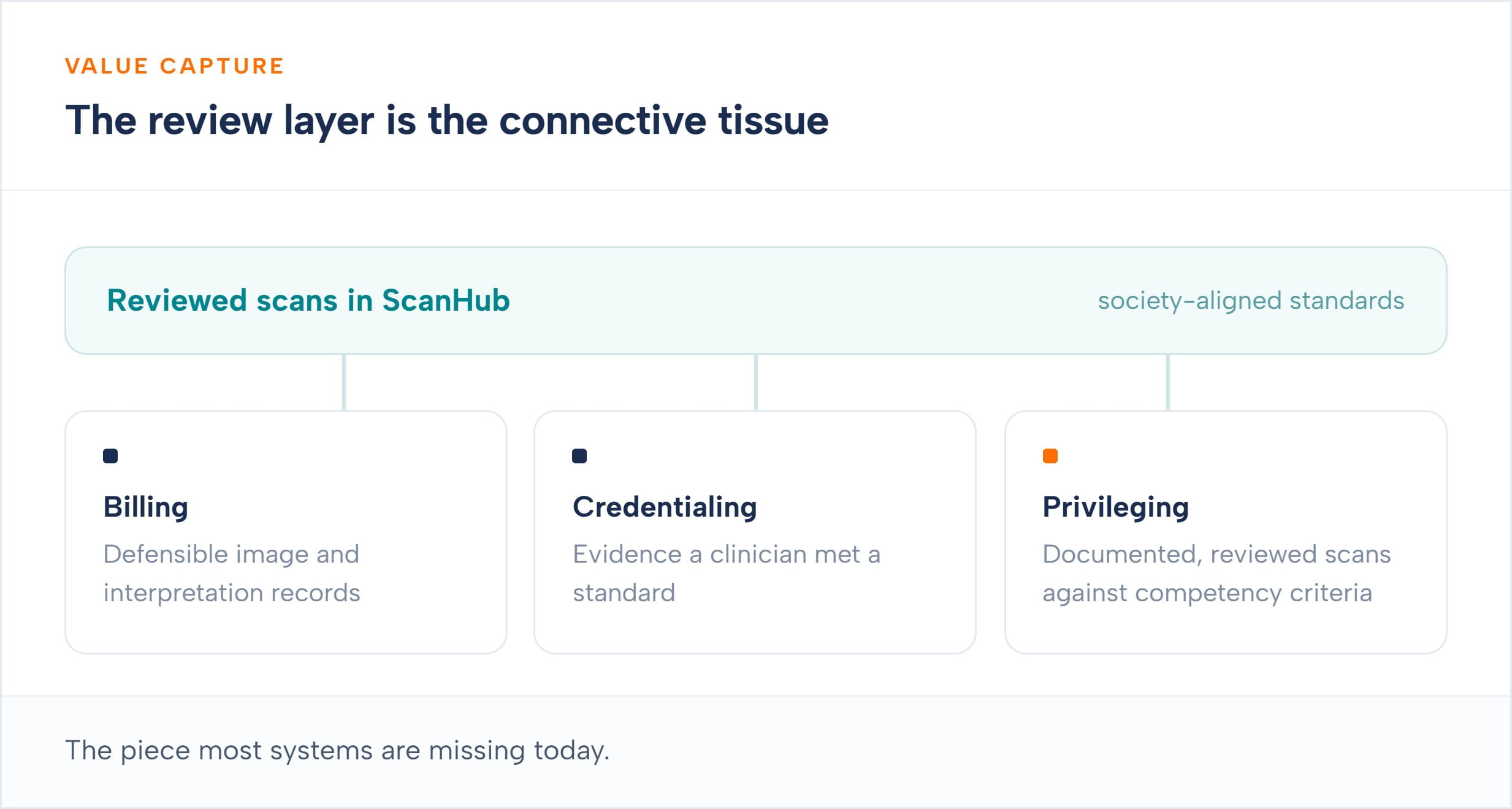
Ultrasound at the bedside creates value only if it is done well and documented. When scanning is inconsistent or unreviewed, a health system carries the clinical and medico-legal exposure of the technology without reliably capturing its upside. Instant Review addresses the first half of that equation — making sure scans meet a standard and that learners are improving — while centralized, reviewed scans in ScanHub support the operational half: the billing, credentialing, and privileging workflows that turn POCUS from an enthusiast’s tool into a system capability.
These operational threads are tightly linked. Privileging often requires documented, reviewed scans against competency criteria. Billing requires defensible image capture and interpretation records. Credentialing requires evidence a clinician has met a standard. A consistent, well-documented review layer is the connective tissue that makes all of it work — and it is the piece most systems are missing today.
Institution-wide standardization
The value of a standard grows with its reach. When every department that uses ultrasound holds the same expectations — reviewed the same way, against the same society-aligned criteria — a health system can make claims it otherwise cannot: that its POCUS is uniformly competent, that quality is monitored, and that outcomes are tracked. Instant Review provides that uniform layer without requiring each department to build its own review process from scratch.
This is not just a departmental tool used widely; it is infrastructure for a system-level quality program. It aligns naturally with the guidelines of the societies your specialties already follow, which is why the messaging around medical societies and device partners runs through the administrator conversation as much as the clinical one.
What administrators get
System-wide QA and standardization
Value capture: billing, credentialing, privileging tie-ins
Longitudinal outcomes for governance and reporting
An education-first posture that limits regulatory exposure
Where quality, value, and risk meet
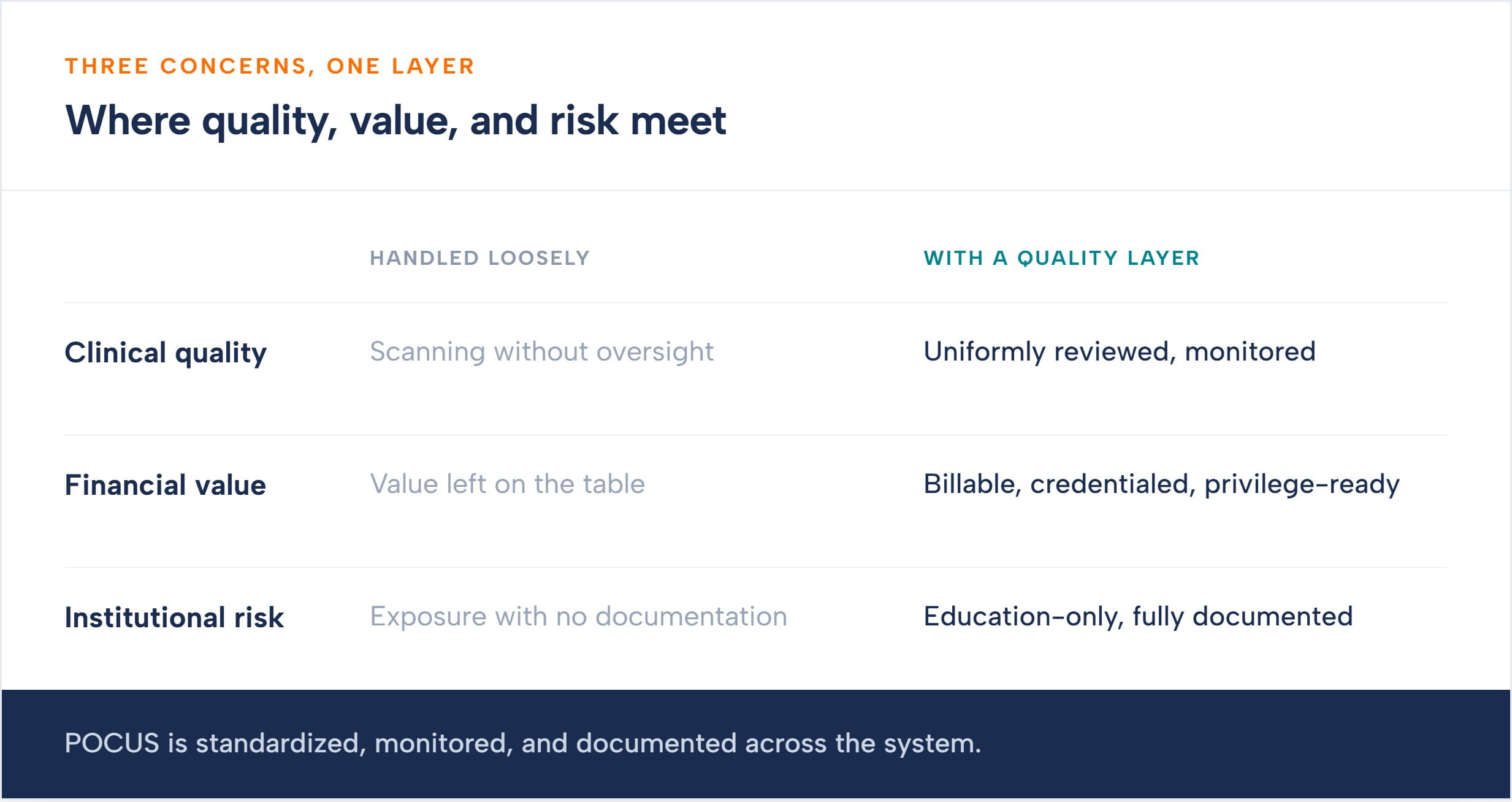
For an administrator, POCUS sits at the intersection of three concerns that are usually managed separately: clinical quality, financial value, and institutional risk. Handled well, point-of-care ultrasound improves care, captures reimbursable value, and strengthens the system’s standing. Handled loosely, it becomes an unmonitored liability — clinicians scanning without oversight, value left on the table, and exposure with no documentation to answer for it. The difference between those two outcomes is a quality layer, and that is precisely the gap Instant Review fills.
The value-capture argument is often the one that moves fastest at the executive level. Privileging clinicians for POCUS typically requires documented, reviewed scans against competency criteria; billing for ultrasound requires defensible image and interpretation records; credentialing requires evidence that a standard was met. Each of those workflows depends on exactly what most systems lack today — a consistent, well-documented review process. Centralized, reviewed scans in ScanHub, evaluated against society-aligned standards, become the connective tissue that turns scattered scanning into a billable, credentialed, privilege-ready capability.
The risk argument is the mirror image. Because Instant Review is education and quality-assurance only — never diagnostic — it strengthens governance without dragging the institution into the regulatory and liability territory a diagnostic device would occupy. It gives leadership a defensible story: POCUS is standardized, monitored, and documented across the system. For the one-on-one conversations and executive meetings where these decisions are actually made, that story, backed by longitudinal data, is the entire point — and it is what the materials here are designed to support.
Governance, security, and a safe rollout
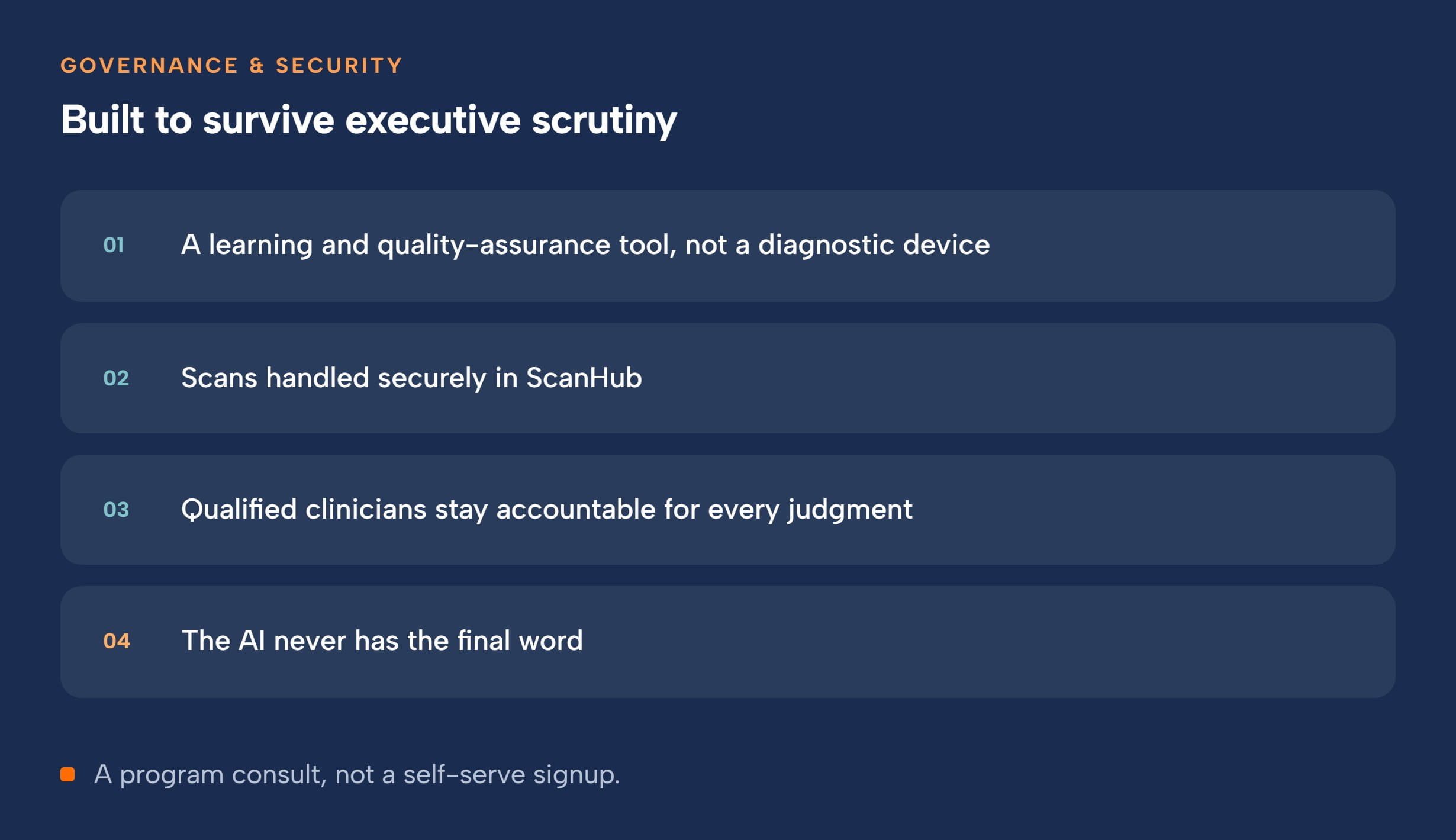
Administrators evaluate tools through the lens of risk, and Instant Review is designed to survive that scrutiny. It is a learning and quality-assurance tool, not a diagnostic device — a distinction that keeps it out of the regulatory and liability category that clinical decision-making would trigger. Scans are handled securely in ScanHub, and qualified clinicians stay accountable for every judgment — the AI never has the final word. For governance and compliance readers, the education-first and safety page is written to be shared directly.
Because these decisions are made at the executive level, the materials matter as much as the product. Instant Review is meant to give leadership the language and evidence to make the case — in one-on-ones, committee meetings, and system-wide planning — for POCUS as a governed capability. The path forward is a program consult framed for institutional stakeholders, not a self-serve signup.
Making the internal case
Administrators rarely adopt a tool alone; they build a case for it among peers, committees, and executive stakeholders. Instant Review is designed to make that case easy to carry. The argument has three legs, each aimed at a different concern in the room. For quality, it guarantees that every scan across the system is reviewed against a consistent, society-aligned standard rather than left to chance. For value, it supplies the documented, reviewed scans that billing, credentialing, and privileging workflows depend on. For risk, it strengthens oversight while staying firmly education-only, keeping the institution clear of diagnostic-device liability.
Backed by longitudinal data, those three legs turn into a story leadership can tell with confidence: POCUS across the system is standardized, monitored, documented, and improving. That is the narrative that unlocks budget and buy-in in the one-on-ones and executive meetings where these decisions actually happen. The materials here — and a consult framed for institutional stakeholders — are built to arm exactly that conversation, so an administrator walks in with evidence rather than enthusiasm.
Didn’t find your answer?
No worries! If you have any other questions or need more information, feel free to reach out directly.
Have more questions? Send us a message.
Frequently Asked Questions
How does Instant Review™ help standardize POCUS across a health system?
Instant Review™ applies a consistent, society-aligned review framework across supported scans, helping departments work from the same expectations for image quality, completeness, probe technique, and anatomical visualization. This creates a common quality layer across teams while giving leadership a clearer view of how POCUS is being used and how clinicians are progressing over time.
How does Instant Review™ fit into POCUS governance and quality assurance?
Instant Review™ provides structured, documented feedback on ultrasound acquisition quality while remaining an education and quality-assurance tool rather than a diagnostic device. Through ScanHub, health systems can centralize reviewed scans, monitor performance over time, and build a more consistent QA process while qualified clinicians and institutions retain responsibility for clinical interpretation and patient care.
Can Instant Review™ support credentialing, privileging, and billing workflows?
Instant Review™ can help create the structured review records and longitudinal evidence that support broader POCUS governance workflows, including credentialing, privileging, competency documentation, and quality reporting. Centralized scan records can also support the documentation processes associated with billing. Specific requirements remain subject to institutional policies, payer rules, and applicable regulatory standards.