

Feedback while the scan is still fresh
If you're learning to scan
Specific, actionable feedback while the scan is still fresh
A private coach — safe to make mistakes and fix them
See your progress across scans over time
Available 24/7, and pairs with your courses and fellowships
Targeted, not generic
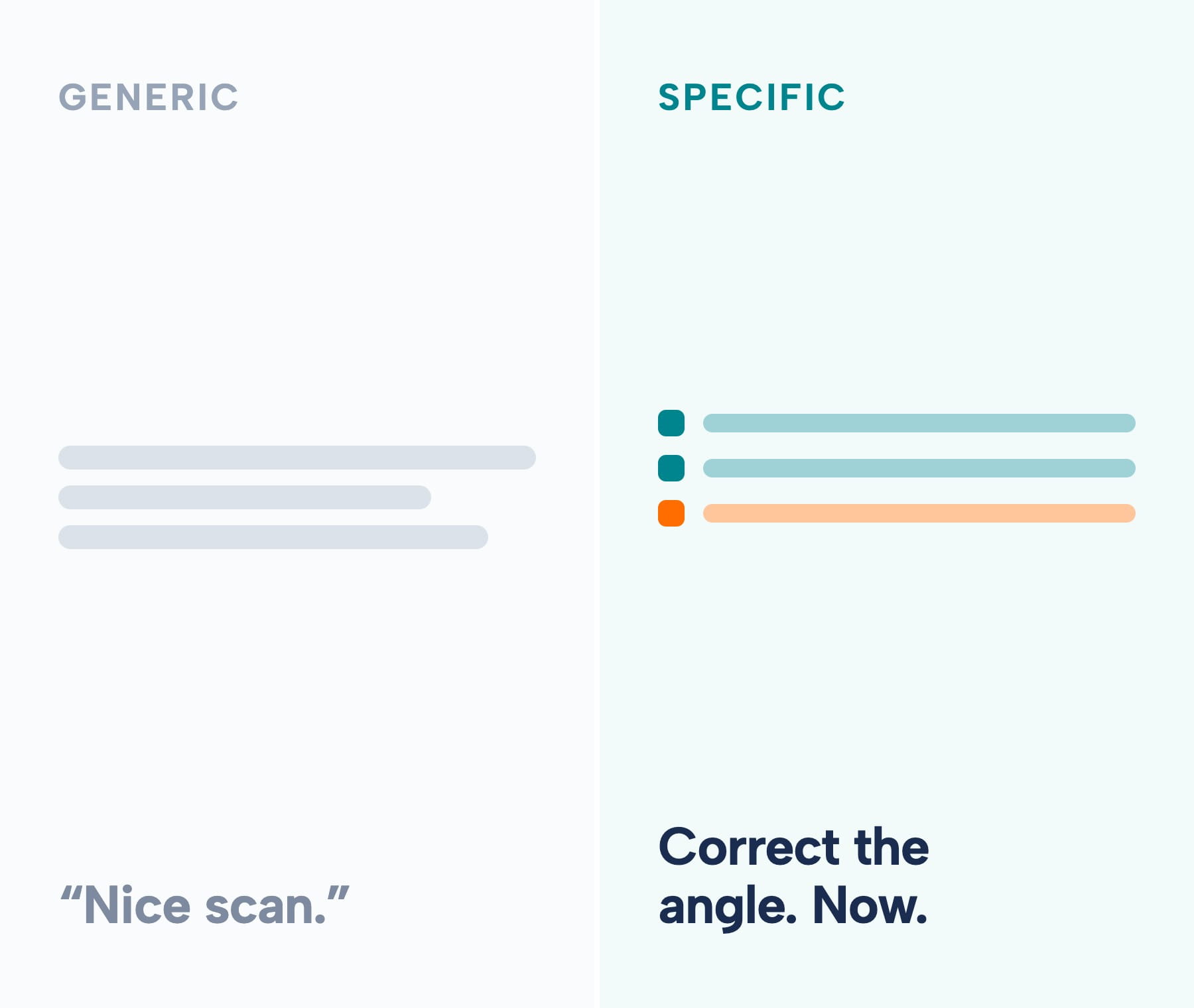
Generic feedback — “nice scan,” “work on your views” — does not change behavior because it does not tell you what to do differently. Instant Review is built to be specific. It tells you that a particular view was foreshortened and how to correct the angle, that your gain washed out a structure and where to set it, that you needed an orthogonal plane to prove continuity. Each recommendation is something you can act on with the very next patient.
That specificity is what makes the feedback stick. When the guidance is concrete and it arrives while the scan is still in your hands, the correction lands in muscle memory instead of evaporating into a vague intention to “do better next time.”
The practice loop
Skill compounds through a tight loop: scan, get feedback, improve, repeat. The slower the loop, the less you learn per rep — which is why waiting days for a supervisor’s comments is so costly. Instant Review shrinks the loop to minutes. You scan, you receive a structured report, you understand exactly what to change, and you apply it immediately. Over dozens of scans, those fast corrections add up to real, durable competence.
And because the feedback is consistent, you can actually see yourself improving. The same categories, scan after scan, turn into a trajectory — the kind of visible progress that keeps you motivated and shows you where to focus next.
Scan → Feedback → Improve → Repeat
A feedback loop measured in minutes, not days. Every scan is a rep that moves you forward, available 24/7 so you can learn on your schedule.
Safe to fail
Learning ultrasound means being bad at it for a while, and that is much easier when the feedback comes from a patient, private coach rather than a judgmental audience. Instant Review is exactly that. It is a learning tool, not a grader looking over your shoulder — a place to make mistakes, understand them, and fix them without the anxiety of a live critique. The transparency is intentional: you build real skill and a real sense of your own limits, rather than a false confidence that could hurt a patient.
That is why Instant Review never pretends to be a diagnostic authority. It is honest about being a coach for your technique, which is precisely what makes it safe to lean on while you learn. The education-first page explains that boundary in full.
Pairs with your training
Instant Review is most powerful alongside structured learning. It complements GUSI’s courses and fellowships by turning didactic knowledge into practiced skill — you learn the technique in a course, then use Instant Review to refine it scan after scan in real practice. For the tens of thousands of clinicians already learning with GUSI, it is the missing feedback layer between watching a lesson and mastering the probe.
Instant Review is in pre-launch. Join the waitlist and we will reach out when early access opens — and if you are part of a program or a group, the educator, program, and administrator pages describe how teams get started together.
How to get the most out of it
Instant Review rewards a particular habit: scan deliberately, read the report closely, and change exactly one thing on your next attempt. The clinicians who improve fastest are not the ones who scan the most; they are the ones who turn each report into a specific, testable adjustment — a different probe angle, a corrected gain, an added orthogonal view — and then confirm on the next scan that it worked. Treat every report as an experiment and every scan as the test.
Read for the pattern, not just the individual scan. Because the feedback is consistent, the same weakness showing up across several reports is a louder signal than any single note. If completeness keeps costing you points, that is where a focused practice block will pay off; if it is always technique on one particular view, drill that view. The longitudinal view exists precisely so you can see these patterns and aim your practice, rather than spreading effort evenly and hoping.
Use the safety of a private coach to push yourself. Because Instant Review is a learning tool and not a graded audience, the smart move is to attempt the views you are least confident in — the ones you would avoid if a supervisor were watching — and let the fast feedback teach you where the edges of your skill actually are. Building real skill means being comfortably bad at something long enough to get good at it, and a patient, always-available coach makes that far easier.
Finally, pair it with structure. Instant Review sharpens skill fastest when it sits alongside a course or fellowship that supplies the underlying knowledge; the lesson teaches you what a good scan should look like, and Instant Review helps you produce one, scan after scan, until it is second nature.
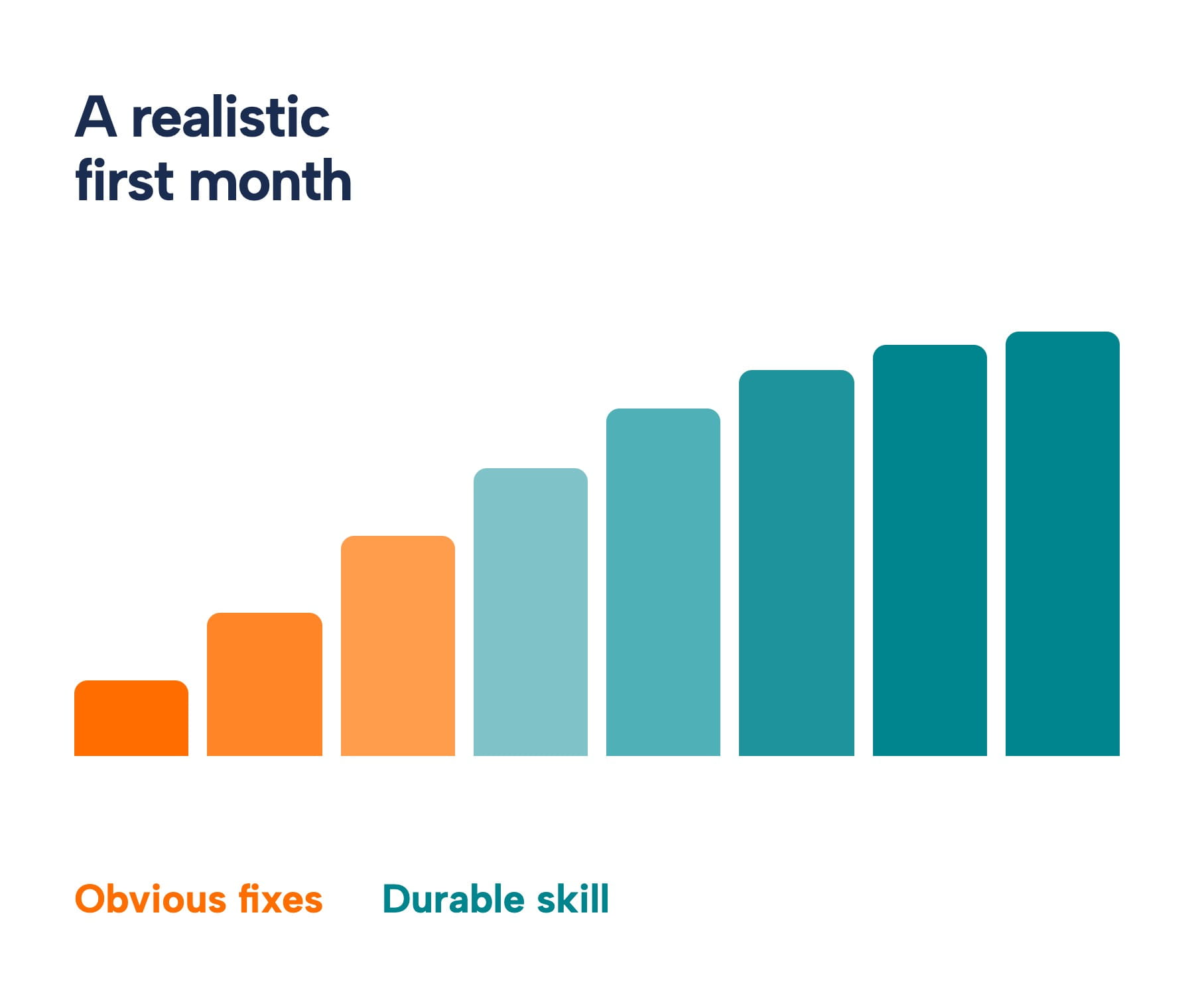
A realistic first month
It helps to know what improvement actually feels like, because it is rarely a straight line. In an honest first month with Instant Review, the early scans surface a cluster of specific, fixable issues — a view you consistently foreshorten, a gain setting you misjudge, an orthogonal plane you skip. The reports name them plainly, and because the feedback is immediate you can attack them one at a time rather than absorbing a vague sense that you need to be better. Progress in the first weeks is mostly the satisfying kind: obvious mistakes, clearly corrected.
By the end of the month the curve flattens into real skill-building, where the gains are smaller but more durable, and the longitudinal view starts to show a trajectory rather than scattered scores. This is the point at which many learners find their motivation shifts from anxiety about being judged to curiosity about how much better they can get — precisely because the coach is private, patient, and available whenever they scan. Pair the habit with a course or fellowship for the underlying knowledge, attack one issue per scan, and read for the pattern across reports, and a month of deliberate practice with fast feedback does more than a year of scanning into the void.
Didn’t find your answer?
No worries! If you have any other questions or need more information, feel free to reach out directly.
Have more questions? Send us a message.
Frequently Asked Questions
What kind of feedback will I get from Instant Review™?
Instant Review™ provides specific coaching on areas such as image quality, completeness, probe technique, and anatomical visualization. Instead of generic comments, the feedback explains what could be improved and gives practical next steps you can apply to your next scan.
How quickly will I receive feedback on my scan?
Instant Review™ is designed to return feedback in minutes, so you can review it while the scan and your technique are still fresh. That short feedback loop makes it easier to understand what went wrong, make an adjustment, and apply the correction on your next attempt.
Can I see how my scanning skills improve over time?
Yes. Because Instant Review™ evaluates supported scans using consistent criteria, you can see patterns across your scans rather than treating each one as an isolated result. Over time, this helps you identify recurring strengths and weaknesses, focus your practice, and see how your technique is progressing.

Get early access
Book a consult
For educators, faculty, programs, and administrators evaluating Instant Review for a group.
For educators, faculty, programs, and administrators evaluating Instant Review for a group.
"*" indicates required fields
Join the waitlist
For individual learners and fellows who want early access when it opens.
For individual learners and fellows who want early access when it opens.
"*" indicates required fields