

A learning tool, on purpose
Scope & safety, plainly
A learning and quality tool — not a diagnostic device
Never guides treatment or replaces a qualified reader
Transparent about what it covers and where it can be wrong
Coaching guidance only — never a competence determination
Scope: learning and quality assurance only
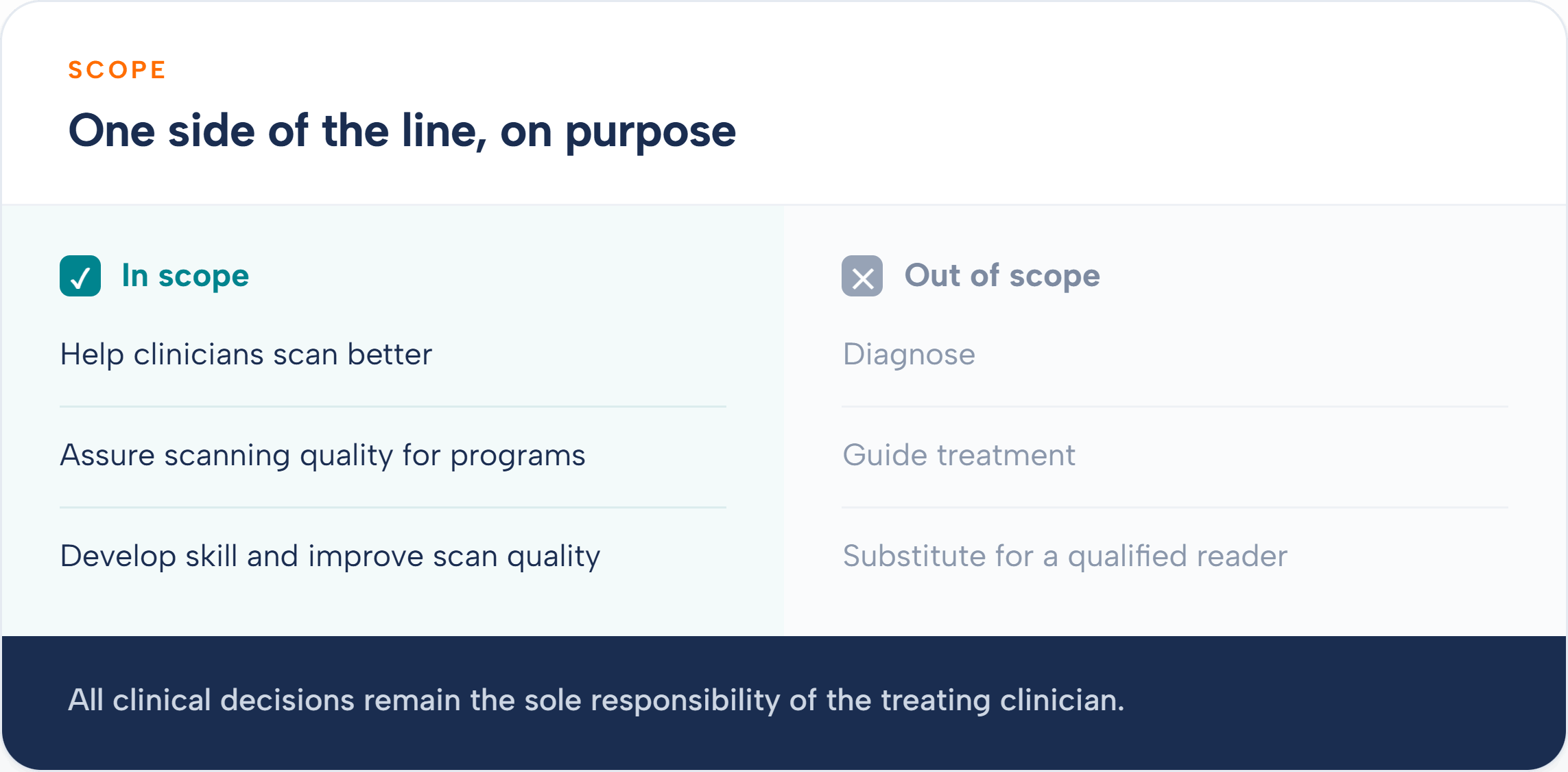
Instant Review has one job: to help clinicians scan better and to help programs assure the quality of that scanning. It does not diagnose, it does not guide treatment, and it does not substitute for a qualified reader or the treating clinician’s judgment. Every piece of feedback it produces is intended to develop skill and improve scan quality — nothing more. All clinical decisions remain the sole responsibility of the treating clinician.
Drawing that line clearly is what keeps the tool both useful and safe. A product that blurs the boundary between education and diagnosis invites misuse and regulatory exposure. By staying firmly on the education-and-quality side of the line, Instant Review can be adopted broadly, quickly, and with confidence.
Instant Review™ is a learning and quality-assurance tool, not a clinical diagnostic tool. AI-generated feedback supports skill development and scan-quality improvement only. It should not be used to guide clinical decision-making or replace qualified medical judgment.
Transparent AI
Transparency is a safety feature. Because Instant Review explains its reasoning in the language of established standards, learners understand why a scan fell short rather than simply accepting a verdict. That builds genuine skill and, just as importantly, a realistic sense of one’s own limits — the opposite of the false confidence a black-box “it looks fine” could instill. A learner who understands the standard is a safer clinician than one who has outsourced judgment to a machine.
This is why the tool is designed to teach rather than to certify clinical accuracy. Its transparency keeps the learner thinking, which is exactly where the learning — and the responsibility — belongs.
What it does / does not do
Does: coach technique & image quality
Does: assure quality against standards
Does not: diagnose or interpret clinically
Does not: certify competence
Does not: guide treatment decisions
Known limitations, stated plainly
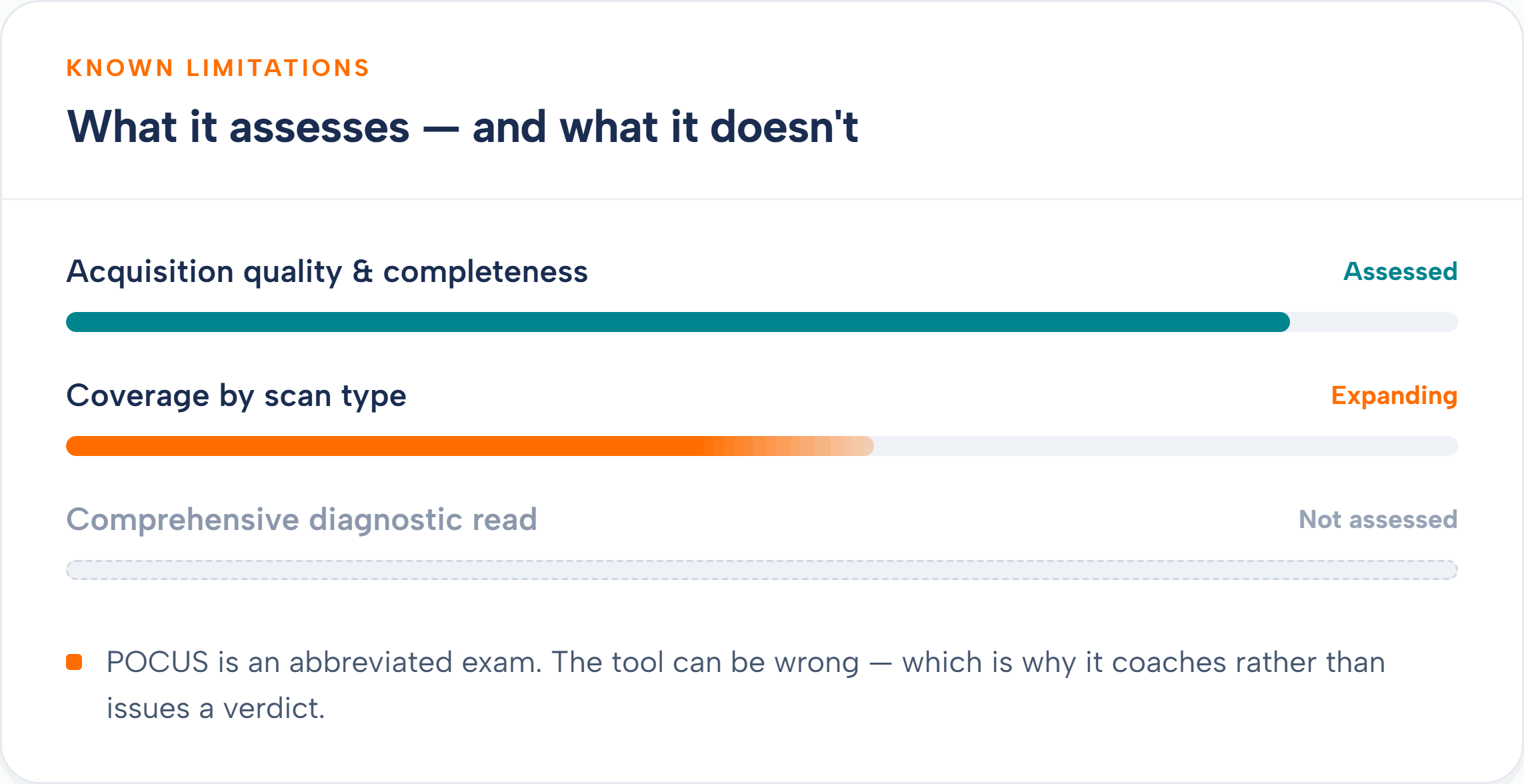
Point-of-care ultrasound is, by design, an abbreviated exam, and any tool that reviews it inherits that scope. Instant Review is candid about what it can and cannot assess: it evaluates the quality and completeness of an acquisition against educational standards, but it is not a comprehensive diagnostic read and will not catch everything a formal study might. Coverage varies by scan type and is expanding over time, and the tool can be wrong — which is precisely why it is framed as coaching rather than a verdict. Owning these limitations openly is part of being education-first; a tool that overstates itself cannot be trusted with a learner’s development.
Built to support your teaching
Instant Review coaches; it does not certify. Its feedback is guidance for a learner’s next scan, not a determination about their competence — and it is explicit with learners about that boundary. Programs can review how the system is performing and confirm the coaching reflects the guidance they want their learners to receive.
Data & privacy
Instant Review coaches; it does not certify. Its feedback is guidance for a learner’s next scan, not a determination about their competence — and it is explicit with learners about that boundary. Programs can review how the system is performing and confirm the coaching reflects the guidance they want their learners to receive.
Responsible AI in medical education
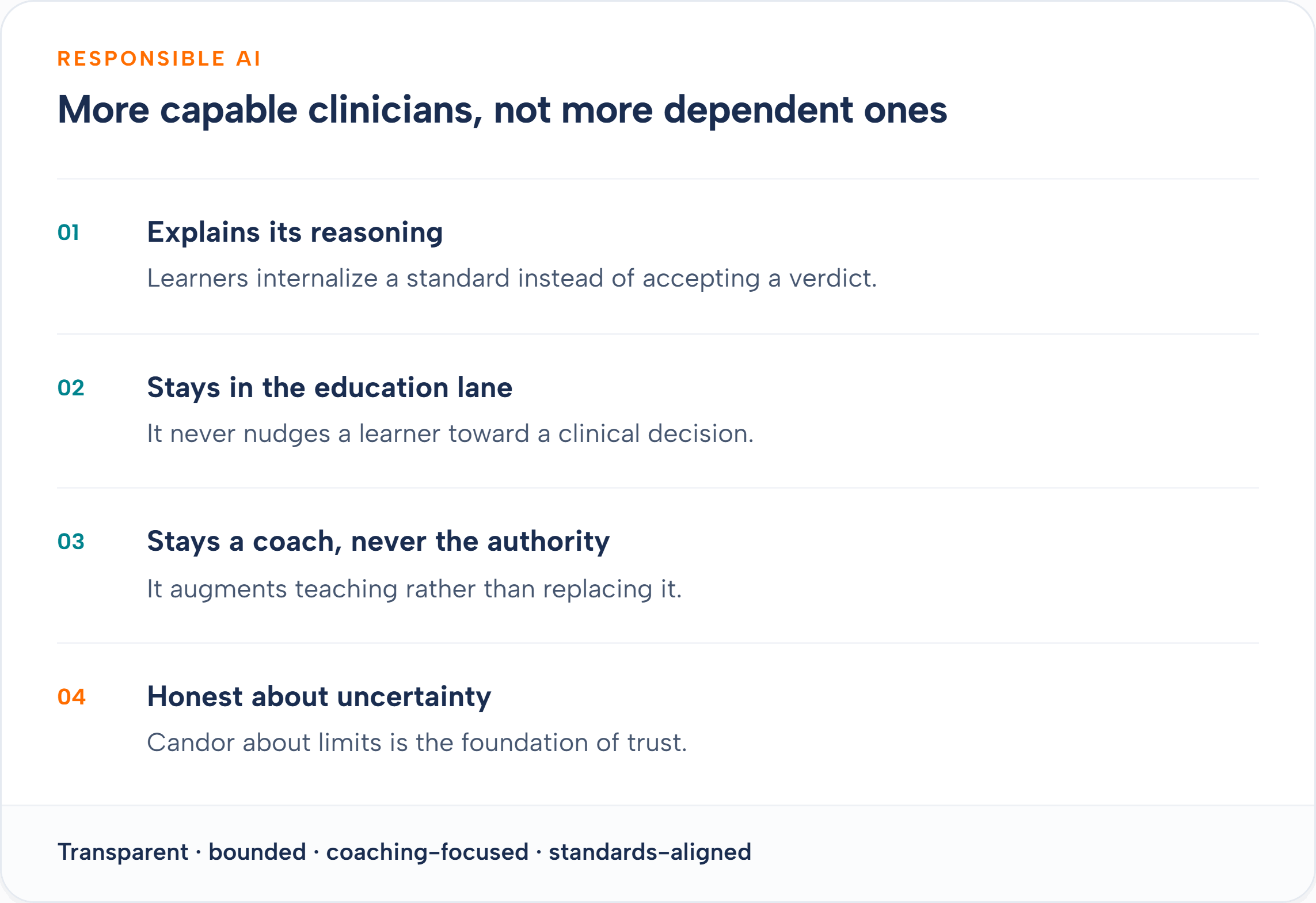
Putting AI in front of learners carries a specific responsibility: the tool must make them more capable clinicians, not more dependent ones. That principle shapes every design choice in Instant Review. It explains its reasoning instead of issuing verdicts, so learners internalize a standard rather than outsourcing judgment. It stays firmly in the education-and-quality lane, so it never nudges a learner toward a clinical decision it has no business informing. And it stays clearly in the role of a coach, so it augments teaching without ever becoming the authority.
Being education-first also means being honest about uncertainty. Instant Review is transparent about what it covers, candid that it can be wrong, and explicit that point-of-care ultrasound is an abbreviated exam with limits any reviewing tool inherits. That candor is not a weakness to be managed; it is the foundation of trust. A learner who is told plainly where a tool’s judgment ends is far safer than one lulled by unwarranted confidence, and a program that adopts a tool honest about its limits is on far firmer ground than one that bought the hype.
For institutions weighing responsible-AI considerations, these choices add up to a tool that is straightforward to defend: transparent, bounded, coaching-focused, and aligned with the standards the field already uses. It is AI in medical education designed to earn its place — by making clinicians better while respecting the seriousness of what they do — rather than by promising more than any model should. That posture is a large part of why Instant Review can be deployed broadly, and why compliance, faculty, and learners can all get comfortable with it.
Point-of-care ultrasound is, by design, an abbreviated exam, and any tool that reviews it inherits that scope. Instant Review is candid about what it can and cannot assess: it evaluates the quality and completeness of an acquisition against educational standards, but it is not a comprehensive diagnostic read and will not catch everything a formal study might. Coverage varies by scan type and is expanding over time, and the tool can be wrong — which is precisely why it is framed as coaching rather than a verdict. Owning these limitations openly is part of being education-first; a tool that overstates itself cannot be trusted with a learner’s development.
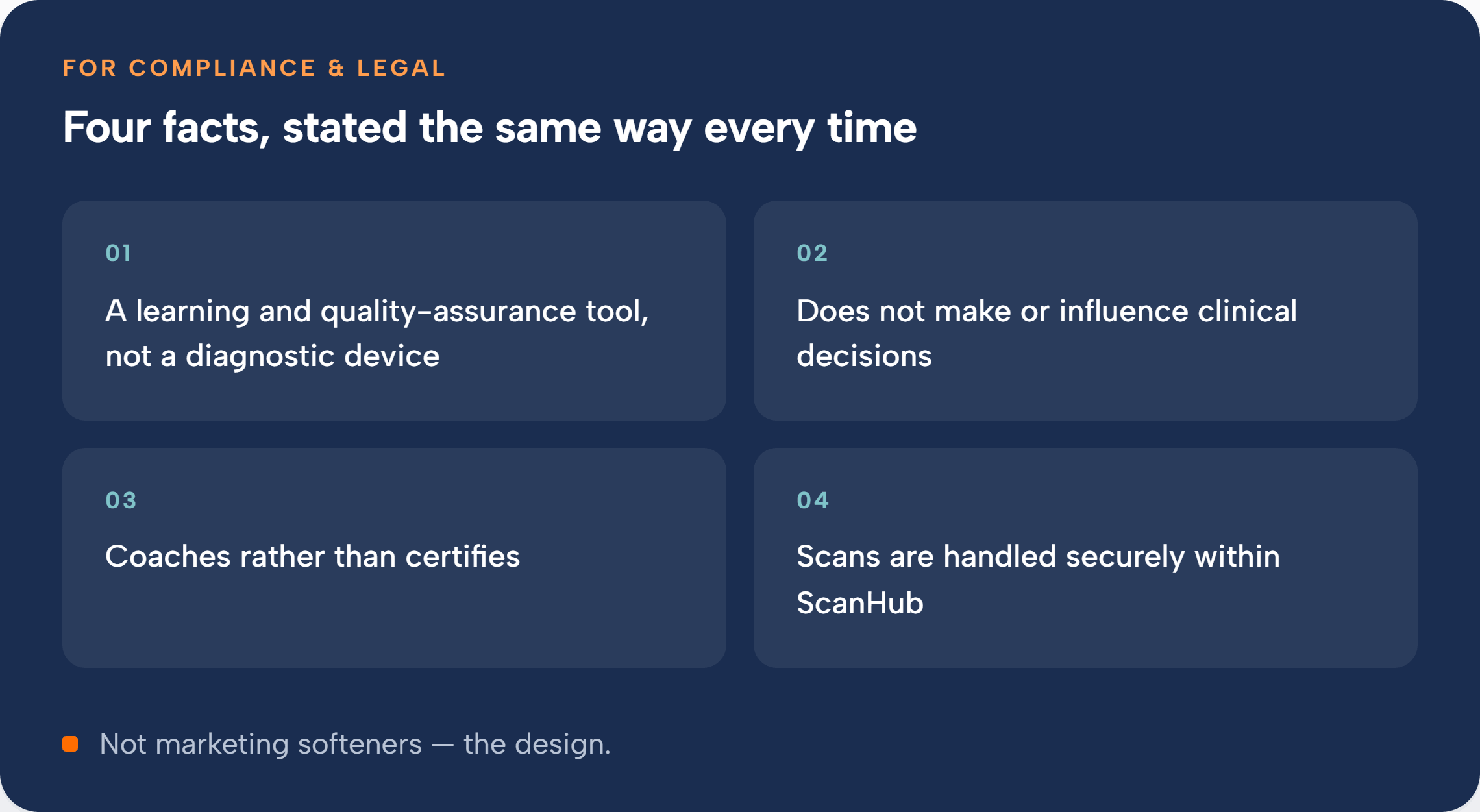
Written to be shared with compliance and legal
Much of this page exists so that a program can hand it to the people who ask the hardest questions. For compliance and legal reviewers, the key facts are simple and consistent: Instant Review is a learning and quality-assurance tool, not a diagnostic device; it does not make or influence clinical decisions; it coaches rather than certifies; and scans are handled securely within ScanHub. Those four statements are not marketing softeners — they are the design, and they are what keep the tool outside the regulatory and liability territory a diagnostic product would occupy.
Reviewers also tend to probe the edges, and Instant Review is built to answer honestly there too. It is candid that point-of-care ultrasound is an abbreviated exam, that coverage varies by scan type and is expanding, and that the model can be wrong — which is exactly why it coaches rather than certifies. A tool that is transparent about its limits and clear about its scope is far easier to approve than one that overstates itself, and that is the deliberate posture here. When deeper detail on data handling, access controls, or governance is needed, a consult is the place to work through it against your institution’s specific requirements.
Didn’t find your answer?
No worries! If you have any other questions or need more information, feel free to reach out directly.
Have more questions? Send us a message.
Frequently Asked Questions
Can Instant Review™ be used to diagnose a patient or guide treatment?
No. Instant Review™ is designed exclusively for education and quality assurance. It evaluates aspects of ultrasound acquisition and provides coaching intended to help clinicians improve their scanning skills. It should not be used to diagnose a condition, guide treatment, or replace interpretation and clinical judgment by a qualified healthcare professional.
What happens if Instant Review™ gets something wrong?
Instant Review™ can be wrong, which is why its feedback is intentionally presented as coaching rather than a clinical verdict. Coverage also varies by scan type and continues to expand. Learners and programs should interpret feedback within its educational scope and rely on qualified clinicians and established institutional processes whenever clinical interpretation or additional review is required.
Does Instant Review™ determine whether a learner is competent?
No. Instant Review™ provides structured feedback that can help learners improve and help educators understand patterns in scan performance, but it does not independently certify or determine clinical competency. Competency decisions remain with the educators, programs, and institutions responsible for assessing the learner.

Get early access
Book a consult
For educators, faculty, programs, and administrators evaluating Instant Review for a group.
For educators, faculty, programs, and administrators evaluating Instant Review for a group.
"*" indicates required fields
Join the waitlist
For individual learners and fellows who want early access when it opens.
For individual learners and fellows who want early access when it opens.
"*" indicates required fields