

Frequently asked questions
Quick answers
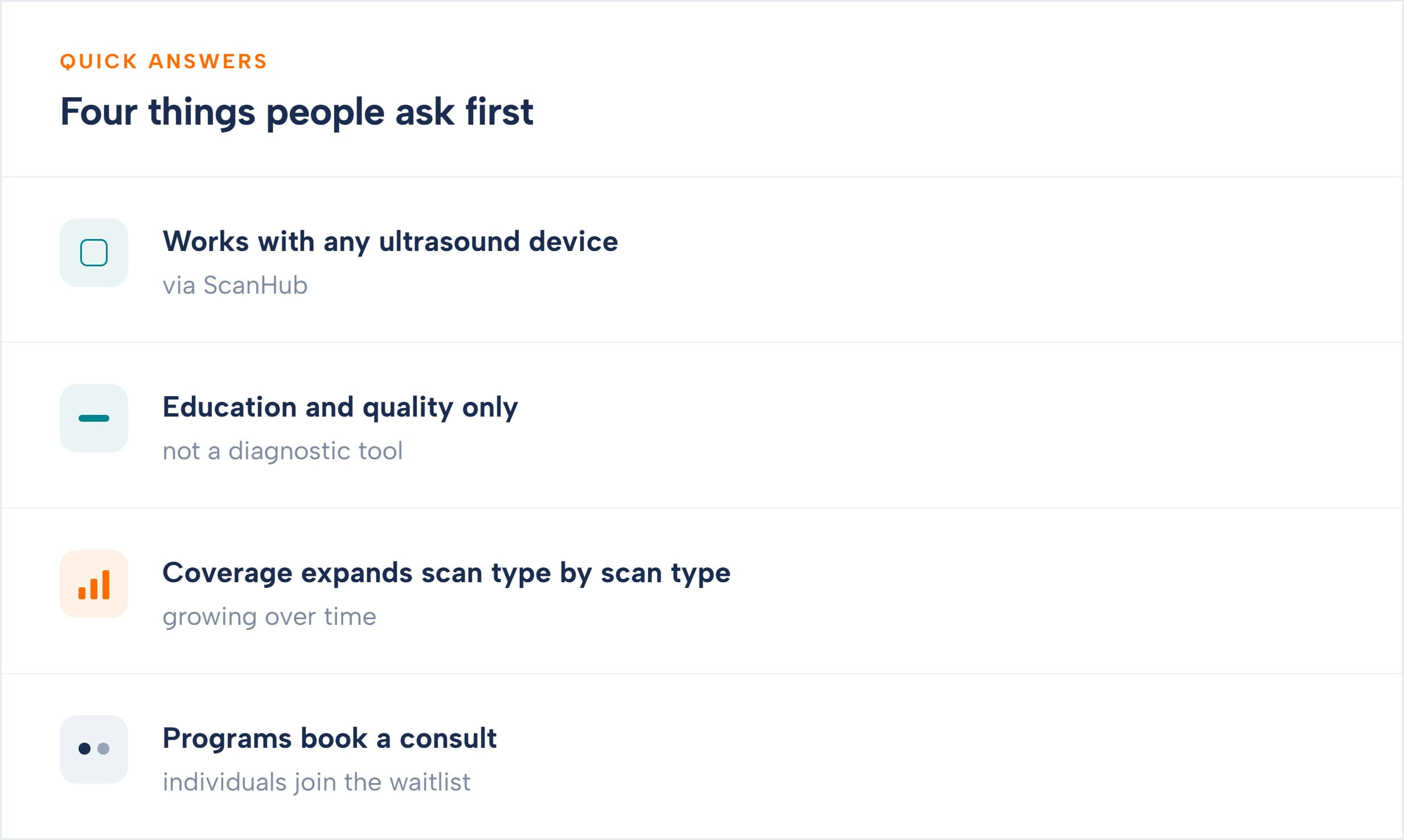
Works with any ultrasound device via ScanHub
Education and quality only — not a diagnostic tool
Coverage expands scan type by scan type
Programs book a consult; individuals join the waitlist
How reliable is the feedback?
The system evaluates supported scans against defined criteria for image quality, completeness, probe technique, and anatomical visualization. Like any AI system, it can make mistakes, which is why Instant Review™ is designed as a coaching and quality-assurance tool rather than a final clinical authority. Programs can keep faculty oversight wherever additional judgment is needed.
Can I use the feedback to make a clinical decision?
No. The feedback is intended to help clinicians improve how they acquire ultrasound images, not determine what those images mean clinically. Instant Review™ does not diagnose conditions, recommend treatment, or replace interpretation and judgment by a qualified healthcare professional.
Which POCUS exams can it review?
Coverage is being expanded scan type by scan type rather than claiming support for every possible POCUS examination from day one. The GUSI team can confirm the currently supported exams and findings for your specialty or program during onboarding.
Will we need to replace our ultrasound equipment?
No. Scans are submitted through GUSI ScanHub™, so Instant Review™ is not tied to a specific ultrasound manufacturer. Programs can continue using the handheld or cart-based devices already built into their scanning workflow.
How much does it cost, and how do we get access?
Pricing depends on how Instant Review™ will be used, including whether you are evaluating access for an individual, cohort, program, or larger institution. Programs and institutional teams can discuss scope and pricing during a consult, while individual clinicians can join the waitlist for early-access details.
What happens to scans uploaded for review?
Scans are managed through GUSI ScanHub™, which provides the central environment for upload, review, and longitudinal tracking. Because institutional requirements can vary, questions about data handling, access controls, governance, and implementation can be addressed in detail during a program consult.
Are faculty still involved?
Yes. The goal is to reduce the volume of routine manual review, not remove educators from the learning process. Instant Review™ can provide the first layer of structured coaching while faculty focus their attention on difficult scans, learner mentoring, assessment, and situations where expert judgment adds the most value.
More questions, answered
Will learners have to change how they scan?
No special scanning hardware or separate acquisition process is required. Learners continue scanning with the devices they already use and submit their acquisitions through ScanHub. The major difference is what happens afterward: feedback can arrive in minutes instead of waiting for a scheduled review.
How is Instant Review different from just asking a general AI model?
A general AI model is not purpose-built around POCUS education or a defined scan-review framework. Instant Review™ applies structured, society-aligned criteria to supported examinations so feedback is consistent, repeatable, and designed specifically to teach ultrasound acquisition rather than generate an open-ended interpretation.
Can a program keep its own faculty expectations and teaching approach?
Yes. A consistent review framework does not mean faculty lose their teaching philosophy or authority. Instant Review™ establishes a common baseline for routine coaching, while educators remain responsible for how that feedback fits into their curriculum, assessment process, and broader expectations for learners.
What happens when a scan is unusual or difficult to evaluate?
Not every acquisition should receive a forced automated conclusion. When additional judgment is required, the appropriate next step is human review. That boundary is intentional: Instant Review™ is designed to automate routine coaching while leaving uncertain, complex, or higher-stakes decisions with qualified people.
Can learners see patterns in their feedback over time?
Yes. Because supported scans are evaluated using consistent categories, repeated reviews can build a longitudinal picture rather than a collection of disconnected scores. Learners can see recurring strengths and weaknesses, while programs can identify broader trends across individuals and cohorts.
Who gets the most value from Instant Review™?
It is designed for clinicians learning or refining POCUS skills, educators managing scan review, programs trying to standardize training, and institutions building stronger quality-assurance processes around POCUS. The value looks different for each audience, but the underlying goal is the same: faster, more consistent feedback and a clearer record of improvement.
Is Instant Review™ available now?
Instant Review™ is currently in pre-launch. Programs, faculty, and institutional teams can request a consult to discuss early adoption or a pilot, while individual clinicians and learners can join the waitlist for early-access updates.
When can we start?
Instant Review is in pre-launch, and early participants get priority access, onboarding support, and input into the roadmap. The fastest path is a consult for programs or the waitlist for individuals; both reach the GUSI team directly.
Even more questions
Can I use Instant Review™ if I am not part of a formal training program?
Yes. Individual clinicians and learners are part of the intended audience. If you are interested in using Instant Review™ independently rather than through an institution or training program, the waitlist is the best place to start.
Does it work internationally?
GUSI supports learners in more than 120 countries, and Instant Review is built to extend that reach. Because feedback is automated and always on, it is especially valuable where expert reviewers are scarce — exactly the resource-limited settings where timely POCUS guidance is hardest to come by and most impactful.
Can the scan record support credentialing or privileging?
Structured, reviewed scan records and longitudinal performance data can support the broader documentation used in POCUS credentialing, privileging, competency, and quality-assurance processes. Instant Review™ does not itself grant credentials or privileges, and each institution remains responsible for its own requirements and decisions.
Will it slow down our learners or add steps?
No. Learners upload through ScanHub™ as they already do; the only change is that structured feedback comes back in minutes. There is no new device, no migration, and no added workflow for the learner.
Do we have to launch it across our entire program at once?
No. Programs can start with a defined cohort, fellowship, rotation, or other limited group and evaluate the workflow before expanding. A smaller pilot makes it possible to measure feedback speed, faculty review burden, learner engagement, and other outcomes before deciding how broadly to deploy Instant Review™.

Get early access
Book a consult
For educators, faculty, programs, and administrators evaluating Instant Review for a group.
For educators, faculty, programs, and administrators evaluating Instant Review for a group.
"*" indicates required fields
Join the waitlist
For individual learners and fellows who want early access when it opens.
For individual learners and fellows who want early access when it opens.
"*" indicates required fields