

From: $409 / year

POCUS + Pediatric + OB POCUS Essentials Bundle

Establish a complete ultrasound skillset from core applications through maternal-child specialization. This extensive three-course package starts with essential POCUS fundamentals, then advances into pediatric and pregnancy-specific imaging. Progress through self-paced video lessons with integrated quizzes and performance metrics.

Join 18,000+ Learners

From: $409 / year

Clear

Change Currency:

[wcc_switcher]

49

CME Credits Available

POCUS + Pediatric + OB POCUS Essentials Bundle Description:

This comprehensive three-course bundle is designed for healthcare professionals looking to build a strong foundation in point-of-care ultrasound while developing specialized expertise in both pediatric and obstetric imaging: essential skills for family medicine and primary care providers caring for patients across the lifespan.

The Point-of-Care Ultrasound Essentials course offers 25 CME hours and provides a comprehensive introduction to ultrasound examinations performed at the point of care, enabling clinicians to make rapid, informed decisions across emergency, inpatient, and outpatient settings. Participants will learn ultrasound fundamentals, key anatomical targets, and essential scanning techniques applicable to a wide range of clinical scenarios.

The Pediatric POCUS Essentials course offers 12 CME hours and is specifically designed for healthcare professionals working with pediatric patients. This course provides a clinically grounded approach to diagnosing common conditions in children, emphasizing key pediatric anatomical targets, probe positioning, and scanning techniques. Clinicians will learn how to assess common pediatric issues such as respiratory distress, abdominal pain, trauma, and musculoskeletal injuries with ultrasound.

The Obstetric POCUS Essentials course offers 12 CME hours and provides a practical, hands-on approach to performing ultrasound exams during pregnancy. Participants will learn key anatomical structures, probe positioning, and scanning techniques for evaluating fetal development, placental positioning, and amniotic fluid levels.

Through structured modules and hands-on training, participants will gain the confidence to incorporate POCUS across general, pediatric, and obstetric practice, improving patient care and clinical efficiency throughout the maternal and child health continuum.

Key Benefits:

  • 49 Total CME Hours (25 + 12 + 12)
  • Comprehensive foundational POCUS training plus specialized pediatric and obstetric expertise
  • Self-paced online learning with interactive modules and performance tracking
  • Expert-led instruction from experienced clinicians
  • Real-time ultrasound assessment skills for improved diagnostic accuracy
  • Flexible learning that fits your schedule
  • Certificate of completion for all three courses

Who Should Take This Bundle:

This bundle is ideal for:

  • Family medicine physicians and residents
  • Primary care providers
  • Pediatricians
  • OB/GYN providers
  • Emergency medicine physicians
  • Hospitalists
  • Nurse practitioners and physician assistants
  • Midwives
  • Urgent care providers
  • Any healthcare professional seeking comprehensive POCUS training with focus on maternal and child health

Courses Curriculum

Point-of-Care Ultrasound Essentials Course

Ultrasound Basics Physics and Probes

Ultrasound Basics Scanning Technique

Ultrasound Basics Machine Settings

Ultrasound Basics Artifacts

Ultrasound Basics Summary

FAST/E-FAST Case and Literature

FAST/E-FAST Scanning Technique Part 1

FAST/E-FAST Scanning Technique Part 2

FAST/E-FAST Pathology and Pitfalls

FAST/E-FAST Troubleshooting

FAST/E-FAST Clinical Integration

FAST/E-FAST Summary

Cardiac Echo Case and Literature

Cardiac Echo Scanning Technique

Cardiac Echo Pathology and Pitfalls Part 1

Cardiac Echo Pathology and Pitfalls Part 2

Cardiac Echo Troubleshooting Part 1

Cardiac Echo Troubleshooting Part 2

Cardiac Echo Clinical Integration Part 1

Cardiac Echo Clinical Integration Part 2

Cardiac Echo Clinical Integration Part 3

Cardiac Echo Summary

Pulmonology Case and Literature

Pulmonology Scanning Technique

Pulmonology Pathology and Pitfalls

Pulmonology Troubleshooting

Pulmonology Clinical Integration

Pulmonology Summary

COVID-19 Lung Disease

Gallbladder Case and Literature

Gallbladder Scanning Technique

Gallbladder Pathology and Pitfalls

Gallbladder Troubleshooting

Gallbladder Clinical Integration

Gallbladder Summary

Abdominal Aortic Aneurysm Case and Literature

Abdominal Aortic Aneurysm Scanning Technique

Abdominal Aortic Aneurysm Pathology and Pitfalls

Abdominal Aortic Aneurysm Troubleshooting

Abdominal Aortic Aneurysm Clinical Integration

Abdominal Aortic Aneurysm Summary

Renal Case and Literature

Renal Scanning Technique

Renal Pathology and Pitfalls

Renal Troubleshooting

Renal Clinical Integration

Renal Summary

DVT Case and Literature

DVT Scanning Technique

DVT Pathology and Pitfalls

DVT Troubleshooting

DVT Clinical Integration

DVT Summary

Musculoskeletal Injections: General Principles

Carpal Tunnel Syndrome: Diagnosis and US Guided Injection

Diagnostic Knee: Scanning Technique

Diagnostic Knee: US Guided Injection

Diagnostic Shoulder: Scanning Technique

MSK Shoulder: US Guided Injection

Anterior Hip: Effusion Diagnosis, & Ultrasound-Guided Injection

Musculoskeletal Pathology Review

Posterior Lower Leg: Achilles Tendon, Gastrocnemius, Soleus

Skin Soft Tissue Case and Literature

Skin Soft Tissue Scanning Technique

Skin Soft Tissue Pathology and Pitfalls

Skin Soft Tissue Troubleshooting

Skin Soft Tissue Clinical Integration

Skin Soft Tissue Summary

Introduction to Dermatologic Ultrasound

Dermatologic Sonographic Anatomy

Dermatologic Lumps & Bumps

Common Nail Conditions

Lesions Suspicious for Skin Cancer

Inflammatory Dermatologic Conditions

OB 1st Tri Case & Literature

OB 1st Tri Scanning Technique & Image Interpretation

OB 1st Tri Pathology & Pitfalls

OB 1st Tri Troubleshooting

OB 1st Tri Clinical Integration

OB 1st Tri Summary

OB 2nd & 3rd Trimester Case & Literature

OB 2nd & 3rd Trimester Scanning Technique

OB 2nd & 3rd Trimester Pathology & Pitfalls

OB 2nd & 3rd Trimester Troubleshooting

OB 2nd & 3rd Trimester Clinical Integration

OB 2nd & 3rd Trimester Summary

Curriculum

Pediatric POCUS Essentials Course

Physics and Probes pe

Scanning Technique pe

Machine Settings pe

Artifacts pe

Summary pe

Pediatric FAST Case and Literature (pe)

Pediatric FAST Scanning Technique (pe)

Pediatric FAST Pathology (pe)

Pediatric FAST Pearls and Pitfalls

Pediatric FAST Clinical Integration (pe)

Pediatric FAST Summary (pe)

Pediatric Renal Case & Literature (pe)

Pediatric Renal Scanning Technique (pe)

Pediatric Renal Pathology (pe)

Pediatric Renal Pearls & Pitfalls (pe)

Pediatric Renal Clinical Integration (pe)

Pediatric Renal Summary (pe)

Pediatric Bladder Volume Assessment (pe)

Peds Cardiac Case & Literature (pe)

Peds Cardiac Scanning Technique (pe)

Peds Cardiac Pathology (5m3s) (pe)

Peds Cardiac Pearls & Pitfalls (pe)

Peds Cardiac Clinical Integration (pe)

Peds Cardiac Summary (pe)

Pediatric Lung Case & Literature (pe)

Pediatric Lung Scanning Technique & Image Interpretation (pe)

Pediatric Lung Pathology (pe)

Pediatric Lung Pearls & Pitfalls (pe)

Pediatric Lung Clinical Integration (pe)

Pediatric Lung Summary (pe)

Pediatric Abdomen Case and Literature (pe)

Pediatric Abdomen Scanning Technique (pe)

Pediatric Abdomen Pathology (pe)

Pediatric Abdomen Pearls and Pitfalls (pe)

Pediatric Abdomen Clinical Integration (pe)

Pediatric Abdomen Summary (pe)

Pediatric Ocular Case & Literature (pe)

Pediatric Ocular Evidence for Optic Nerve Sheath Diameter Measurement (pe)

Pediatric Ocular Scanning Technique (pe)

Pediatric Ocular Pathology, Pearls & Pitfalls (pe)

Pediatric Ocular Clinical Integration (pe)

Pediatric Ocular Summary (pe)

Pediatric Neck Mass Case and Literature

Pediatric Neck Mass Scanning Technique

Pediatric Neck Mass Pathology

Pediatric Neck Mass Pearls and Pitfalls

Pediatric Neck Mass Clinical Integration

Pediatric Neck Mass Summary

Skin Soft Tissue Case & Literature (pe)

Skin Soft Tissue Scanning Technique (pe)

Skin Soft Tissue Pathology and Pitfalls (pe)

Skin Soft Tissue Pearls (pe)

Skin Soft Tissue Clinical Integration (pe)

Skin Soft Tissue Summary (pe)

US Guided PIV Case & Literature (pe)

US Guided PIV Scanning Technique (pe)

US Guided PIV Pearls & Pitfalls (pe)

US Guided PIV Summary (pe)

Curriculum

Obstetric POCUS Essentials Course

The Big “Why” Behind OB POCUS Essentials

Physics and Probes

Scanning Technique, Image Optimization and Probe Movement

Machine Settings and Doppler

Artifacts

Summary

Probe Cleaning

The ALARA Principle

Trauma Informed & Gender Inclusive Language

Patient Counseling

Reporting Results

Intro to the “Big 5”

Fetal Number: Intro and Scanning Technique

Fetal Number: Troubleshooting & Clinical Integration

Fetal Heart Rate: Intro & Scanning Technique

Fetal Heart Rate: Troubleshooting & Clinical Integration

Fetal Presentation: Intro & Scanning Technique

Fetal Presentation: Troubleshooting & Clinical Integration

Placental Location: Intro & Scanning Technique

Placental Location: Troubleshooting & Clinical Integration

Amniotic Fluid Assessment Part 1: The Why and How?

Amniotic Fluid Assessment Part 2: Troubleshooting & Cases

Fetal Dating & Biometry: Case and Literature

Overview of Fetal Dating & Biometry

Fetal Dating & Biometry (1st Tri): MSD, CRL

Fetal Biometry Scanning Technique: BPD, HC

Fetal Biometry Pearls & Pitfalls: BPD, HC

Fetal Biometry Scanning Technique: AC

Fetal Biometry Pearls & Pitfalls: AC

Fetal Biometry Scanning Technique: FL

Fetal Biometry Pearls & Pitfalls: FL

Fetal Biometry: Clinical Integration

Fetal Dating & Biometry: Key Points and Summary

OB 1st Trimester Overview : Case and Literature

OB 1st Trimester Overview : Scanning Technique

OB 1st Trimester Overview : Pathology & Pitfalls

OB 1st Trimester Overview : Troubleshooting

OB 1st Trimester Overview : Clinical Integration

OB 1st Trimester Overview : Summary

OB 2nd/3rd Trimester Overview : Case and Literature

OB 2nd/3rd Trimester Overview : Scanning Technique

OB 2nd/3rd Trimester Overview : Pathology & Pitfalls

OB 2nd/3rd Trimester Overview : Troubleshooting

OB 2nd/3rd Trimester Overview : Clinical Integration

OB 2nd/3rd Trimester Overview : Summary

Biophysical Profile : Case and Literature

Biophysical Profile : Scanning Technique

Biophysical Profile : Pearls & Pitfalls

Biophysical Profile : Clinical Integration

Biophysical Profile : Summary

US Evaluation of Postpartum Hemorrhage

US-Guided IUD Insertion

Curriculum
Global Ultrasound Institute proudly works with top universities, institutions and medical facilities across the United States and around the world

Why Choose Global Ultrasound Institute?

Join the world’s leading platform for Point-of-Care Ultrasound (POCUS) education. Empower your medical practice today!
Expert-Led Training
Learn from experienced physicians and ultrasound specialists guiding you every step of the way.
Flexible Learning
Access training anytime, anywhere with our user-friendly platform and on-demand courses.
Innovative Tools
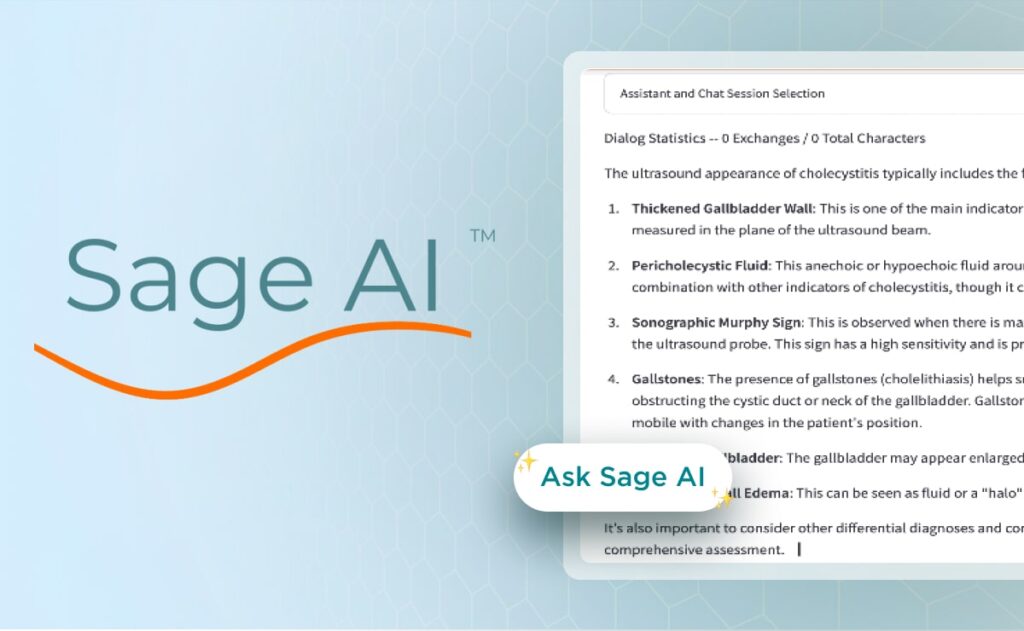
Enhance your skills with Sage AI™, our groundbreaking ultrasound training assistant.
Global Impact
Join a mission to improve healthcare outcomes worldwide, especially in underserved communities.

What you will experience with GUSI’s POCUS + Pediatric + OB POCUS Essentials Bundle

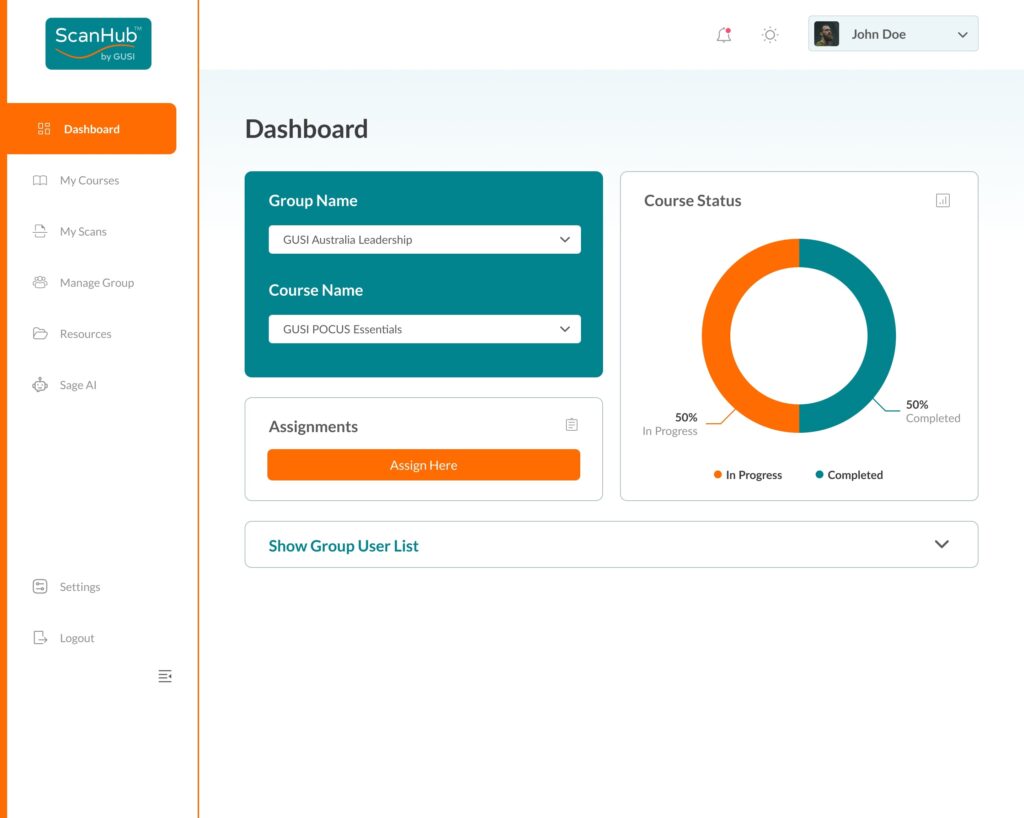
DASHBOARD

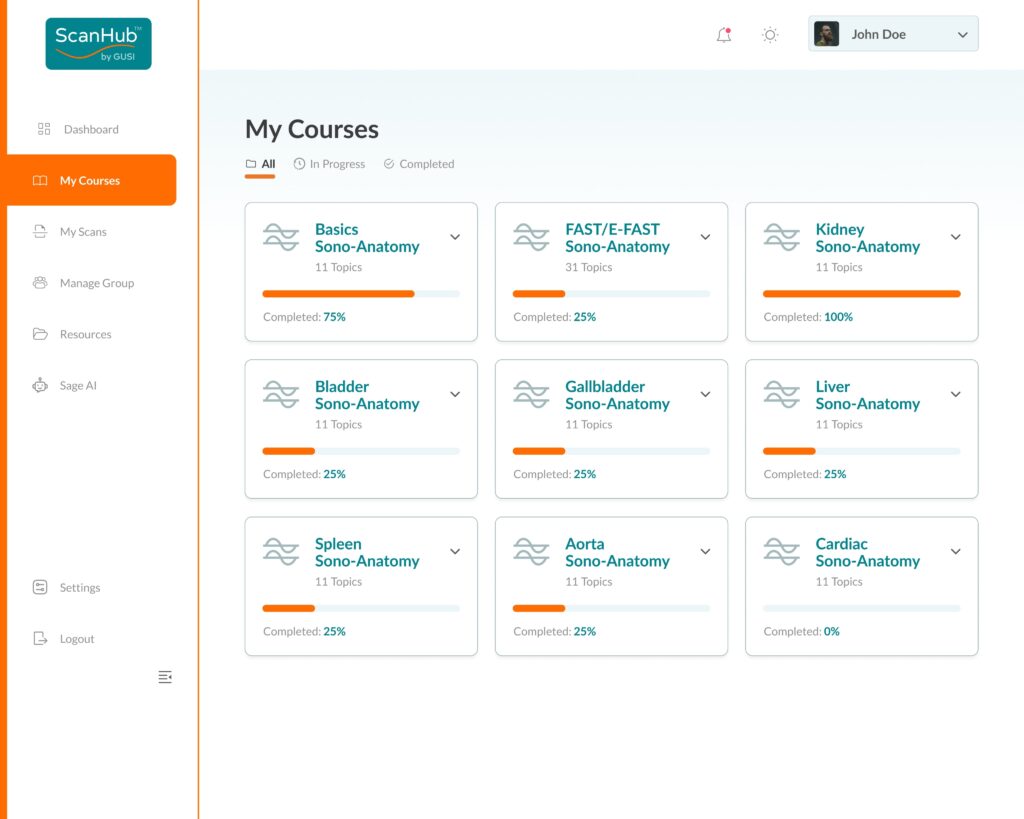
Learning on demand

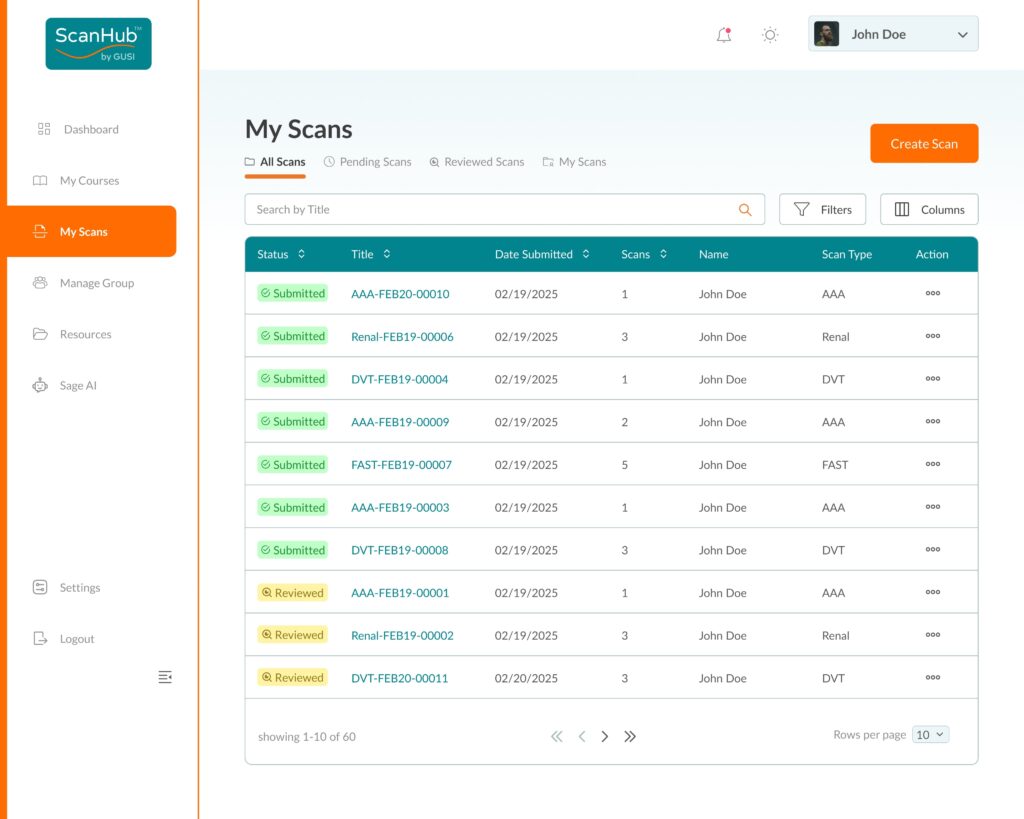
scanFolio Archive

SaGE Ai

What 18,000+ Clinicians Are Saying

Join a growing global network of providers gaining confidence with Point-of-Care Ultrasound. Our trusted, accredited curriculum helps you build real-world skills to elevate patient care.

Learning is made easier by the support provided to each student.

Read More
Dr. Kate Feibusch, MPH
Physician
Kaiser Permanente Santa Rosa Medical Center
Santa Rosa, California

POCUS Has Allowed Me to Find New Excitement in Primary Care, and Reduces Burnout by Providing Quicker Answers to Medical Problems in Real Time.

Read More
Dr Moses J. Syldcort
FM Physician, Advanced OB
Fellow at Swedish First Hill FMR
Seattle, USA

…the GUSI Essentials course has been an amazing addition to our residency’s POCUS program and has freed up my time to spend teaching residents at the bedside.

Read More
Dr. Anna McDonald
Residency
POCUS Champion, Clinical Faculty and Global Health Lead
Swedish First Hill Family Medicine
USA

Being able to do an ultrasound would be a great way for us to get involved in everyday clinic [as medical students].

Read More
Yalnaz Mohasin
Medical Student
Royal College of Surgeons in Ireland
Bahrain

Ready to Advance Your Medical Practice?

  • Built by clinicians, for clinicians
  • Backed by global POCUS training experience
  • Trusted by providers across over 60+ countries
View Our Online CoursesContact Us for a Demo

Didn’t find your answer?

No worries! If you have any other questions or need more information, feel free to reach out directly.

Have more questions? Send us a message.

Contact Sales

Course FAQ’s

This bundle is ideal for family medicine physicians, primary care providers, pediatricians, OB/GYN specialists, emergency medicine physicians, hospitalists, nurse practitioners, physician assistants, and midwives who want comprehensive POCUS training with specialized skills in pediatric and obstetric care.

You’ll gain comprehensive POCUS skills across multiple applications including FAST, cardiac echo, lung, AAA screening, DVT, and procedures, plus specialized training in pediatric ultrasound for respiratory distress, abdominal pain, trauma, and pediatric procedures, and obstetric ultrasound covering fetal assessment, placental location, amniotic fluid evaluation, fetal biometry, and postpartum considerations.

This bundle provides a total of 49 CME hours: 25 AAFP Prescribed credits from POCUS Essentials, 12 AAFP Prescribed credits from Pediatric POCUS Essentials, and 12 AAFP Prescribed credits from Obstetric POCUS Essentials.

Yes! Upon purchase, you’ll have immediate access to all three courses and can progress through them at your own pace. You’ll maintain ongoing access to revisit content and refresh your skills as needed.

By integrating general, pediatric, and obstetric POCUS into your practice, you’ll be able to perform real-time assessments across a comprehensive range of clinical scenarios and patient populations, improving diagnostic accuracy at the bedside, enhancing care from prenatal through pediatric settings, and leading to better patient outcomes across the maternal and child health continuum.

You’ll have access to GUSI’s innovative learning tools including an interactive dashboard to track your progress, on-demand video modules, the scanFolio Archive to build your personal ultrasound library, and Sage AI for intelligent guidance throughout your learning journey.

Empowerment and health equity are the heart of GUSI’s core values. GUSI’s mission is to make the best quality POCUS training affordable and accessible for clinicians worldwide. Price structure varies based on institution, practice setting, and number of participants. Please see our courses for specific pricing.

GUSI’s founder physicians are board-certified family medicine doctors with extensive experience training healthcare professionals across multiple medical specialties. Our comprehensive POCUS training programs welcome clinicians from family medicine, internal medicine, pediatrics, obstetrics and gynecology, midwifery, emergency medicine, and all other medical specialties. All qualified healthcare providers are eligible to enroll in our point-of-care ultrasound certification courses.

Yes. GUSI believes POCUS is the most revolutionary addition to the physical exam since the stethoscope. Our training programs are designed for all medical professionals who perform physical exams. This includes nurse practitioners, physician assistants, nurses, clinical officers, physical therapists, paramedics, EMTs, and more. Everyone can benefit from GUSI’s comprehensive ultrasound training to enhance their clinical practice.

Yes. With backgrounds in global health, GUSI faculty have taught POCUS across Africa, Asia, North and South America. We currently support learners in over 120 countries worldwide. In alignment with our mission for health equity and empowerment, GUSI adjusts its pricing structure for resource-limited settings to improve access and impact.

The GUSI curriculum equips healthcare providers with the skills to confidently use point-of-care ultrasound (POCUS) across diverse clinical settings.

It combines online coursework, review and assessments to support your journey from foundational knowledge to hands-on scanning expertise.

You can choose from flexible options, including:

  • In-person 1–2 day courses for rapid skills development
  • Comprehensive fellowship programs with structured mentorship and certification
  • Self-paced online learning backed by expert-reviewed scan feedback
    GUSI has supported clinicians in over 120 countries and adapts to the needs of global learners and health systems.

Yes. GUSI provides a certificate of completion and a transcript with lessons completed and test scores. Residency directors also receive a template for minimum scanning competency based on AAFP curriculum guidelines.

No. All GUSI content is created independently. We collect Conflict of Interest (COI) disclosures from all course contributors to ensure that no one involved has financial relationships that could bias the educational material. To ensure transparency and trust, we follow best practices in medical education to make sure our content remains objective, evidence-based, and free of commercial influence, especially from companies that sell ultrasound devices or related products.

FAQ's
Join 18,000+ Learners

Ready to build comprehensive ultrasound skills from foundation to specialization?

Start with core POCUS applications and advance into maternal-child health imaging. This complete package takes you from essential techniques to specialized pediatric and obstetric competencies.

Contact Sales Form

"*" indicates required fields

This field is for validation purposes and should be left unchanged.
Your Name*
Please share details that will help us prepare for our conversation.

“Learning is made easier by the support provided to each student.”

GUSI provided education in the areas I wanted and needed, right from my home and office environment. I recommend this curriculum highly. It’s not just the way the course material is presented—learning is made easier by the support provided to each student throughout the program.

“POCUS Has Allowed Me to Find New Excitement in Primary Care, and Reduces Burnout by Providing Quicker Answers to Medical Problems in Real Time.”

POCUS has allowed me to find new excitement in primary care, and reduces burnout by providing quicker answers to medical problems in real time. By improving my diagnostic skills, and increasing my interaction with patients, I hope to continue to have POCUS as an integral part of my practice!

“…the GUSI Essentials course has been an amazing addition to our residency’s POCUS program and has freed up my time to spend teaching residents at the bedside.”

The GUSI essentials online platform is fantastic for high yield asynchronous learning and letting residents learn at their own pace. I recently gave didactics on bleeding and clotting disorders – and spent an hour of that time dedicated to practicing DVT scanning. All residents were asked to complete the DVT module prior to didactics, so we could use our time in person for hands-on transducer time. The very next week I was attending on service and we had a patient come in with unilateral leg swelling; the resident team was able to quickly and confidently diagnose cellulitis based on the clinical picture and cobblestoning seen on US – but they also felt confident to scan for DVT, practicing their skills acquired the week prior. As an educator, you live for these “lightbulb moments” when students can put theory into practice, and feel confident doing so. Overall, the GUSI Essentials course has been an amazing addition to our residency’s POCUS program and has freed up my time to spend teaching residents at the bedside.

“Being able to do an ultrasound would be a great way for us to get involved in everyday clinic [as medical students].”

I feel like medical students should do this program. I think it’s a great way for us to incorporate what doctors teach us how we can be like useful as medical students being able to do an ultrasound would be a great way for us to get involved in everyday clinic.

“”