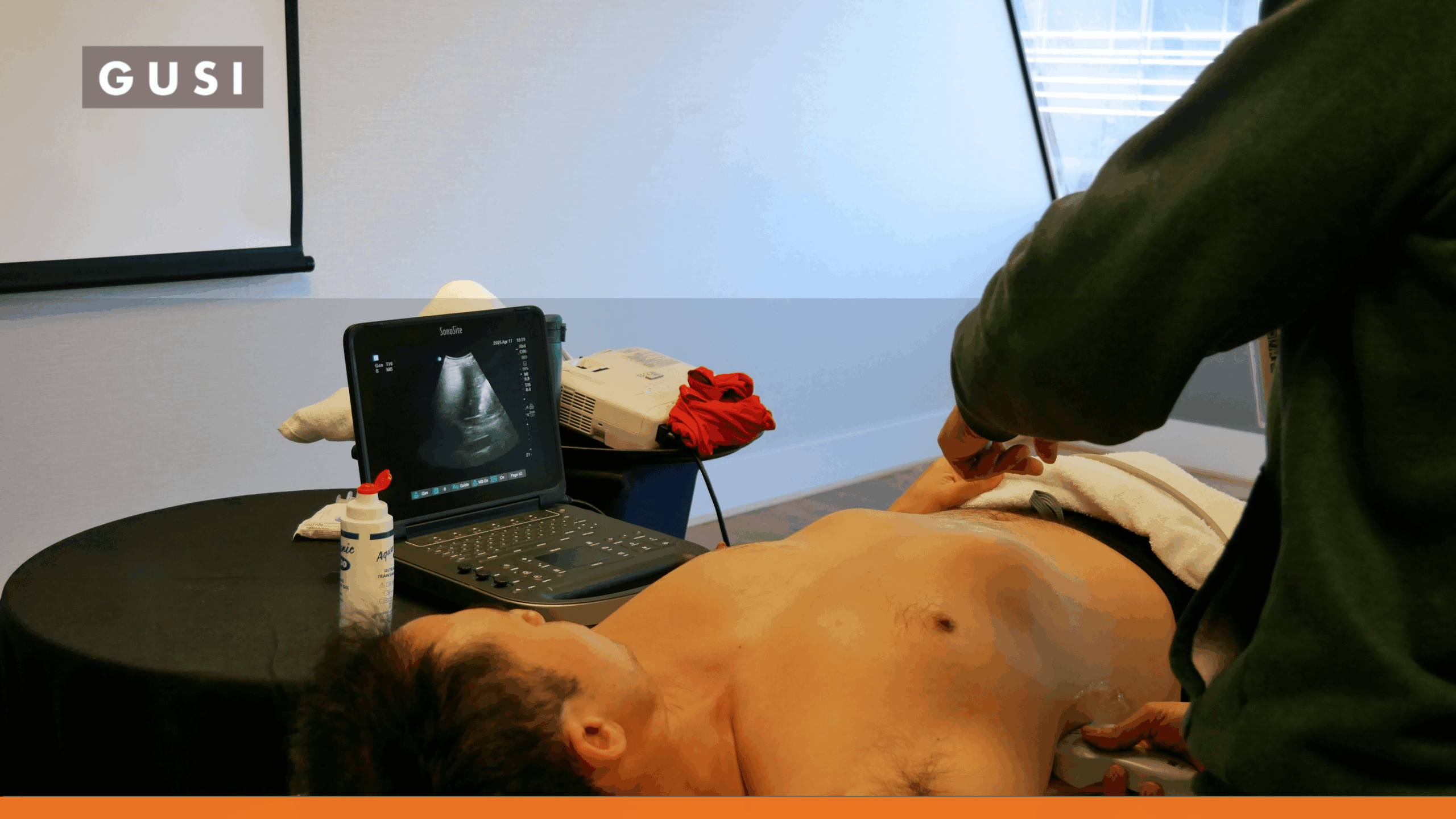


Point-of-care ultrasound is learned through knowledge, hands-on scanning, feedback, repetition, and clinical judgment. Yet many questions arise between courses and supervised sessions: How should the patient be positioned? Which probe and view should be used? Why is an image off-axis? What findings should be considered, and where can the learner find a trusted reference quickly?
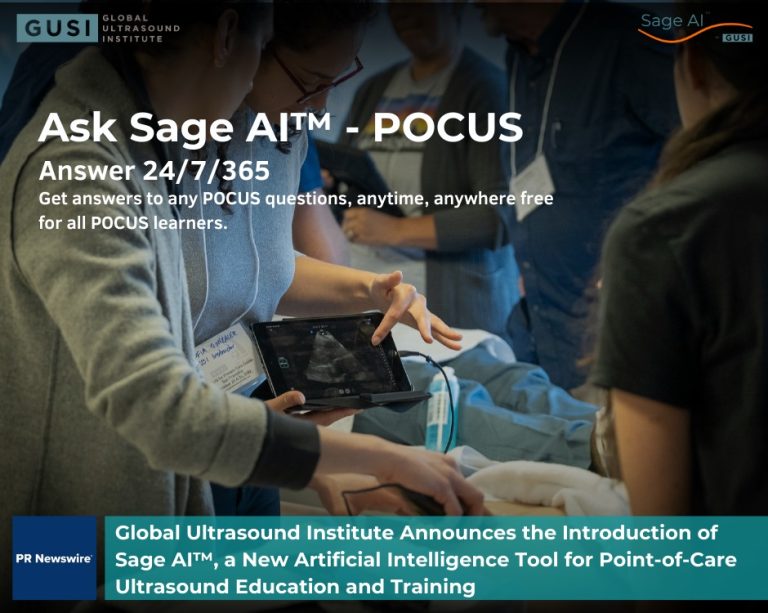
SAGE AI was created by the Global Ultrasound Institute (GUSI) to make that educational support easier to access. Available through GUSI’s learning ecosystem, SAGE AI is an ultrasound-specific assistant that helps users find concise POCUS guidance, related images and videos, scanning protocols, course content, and source references when a question arises.
The Direct Answer
SAGE AI is GUSI’s 24/7 artificial intelligence assistant for point-of-care ultrasound education. It draws from GUSI’s expert-developed learning materials and other vetted medical sources to help clinicians and trainees explore ultrasound concepts, scanning techniques, troubleshooting steps, protocols, and references. It is an educational support tool, not a substitute for patient-specific diagnosis, supervision, competency assessment, or clinical judgment.
The goal is not to place an AI system between the clinician and the patient. The goal is to reduce the time it takes to reach relevant educational material while keeping the learner connected to original sources, structured training, expert feedback, and appropriate escalation.
SAGE AI at a Glance
| Capability | How It Supports POCUS Learning |
|---|---|
| Ultrasound-specific answers | Responds to focused questions about anatomy, image acquisition, optimization, protocols, pathology, and POCUS concepts. |
| Vetted knowledge sources | Uses GUSI’s educational content and curated medical references rather than relying only on unrestricted web search. |
| Images and media | Surfaces related ultrasound images, clips, examples, and course materials when available. |
| Protocols and references | Links learners to scanning protocols, journal citations, and deeper source material. |
| Conversation tools | Supports follow-up questions, deeper explanations, answer verification, and exports, subject to the current product configuration. |
| Speech and mobile access | Supports hands-free and mobile-friendly learning through speech-to-text and responsive access. |
| Multilingual support | Can respond in more than 70 languages, pending final product verification. |
| Always available | Provides on-demand educational support 24 hours a day, 7 days a week. |
Why POCUS Learners Need Answers in the Moment
POCUS is practical. A learner may understand a concept during a lecture, then encounter a different body habitus, probe angle, artifact, or clinical question during scanning. Traditional references remain essential, but finding the exact paragraph, video, or protocol can interrupt the learning process.
In GUSI’s January 2025 article, family physician and ultrasound educator, Dr. Scott Grogan tested practical questions such as how to image the biceps tendon, view the subscapularis tendon, and correct an off-axis apical four-chamber view. SAGE AI returned positioning and troubleshooting guidance with links to related GUSI content, images, videos, and journal sources.
This is where an AI-learning assistant can help: not as a replacement for the instructor, but as a faster pathway back to the curriculum and evidence when an instructor is not immediately available.
How SAGE AI Works
1. Ask a Focused Ultrasound Question
Users can ask natural-language questions instead of searching through multiple menus. Focused questions usually produce more useful responses. “How do I optimize an apical four-chamber view?” is more actionable than “Teach me cardiac ultrasound.”
2. Receive a Concise Answer Grounded in Trusted Sources
SAGE AI is positioned as an ultrasound-specific assistant connected to GUSI’s educational library and curated medical sources. Users should still read cited material, compare the response with local protocols, and recognize when expert review is required.
3. Explore Related Images, Protocols, Videos, and References
POCUS is visual and procedural, so text alone is rarely enough. SAGE AI can connect an explanation to related images, clips, protocols, GUSI lessons, and academic references.
4. Go Deeper, Verify, and Save the Response
Current product messaging describes follow-up explanations, answer-verification tools, speech-to-text, and exports. Confirm the exact current functions before publication.
5. Apply the Information Within Training and Clinical Governance
The final step happens outside the chatbot. Learners still need hands-on scanning, documentation, feedback, quality assurance, and appropriate escalation.
What Can SAGE AI Help You Learn?
| Learning Need | Example Questions |
|---|---|
| Scan preparation | Which probe should I use? How should I position the patient? Which settings should I optimize first? |
| Image acquisition | Where should I place the probe? Which landmark confirms the view? How do I correct an off-axis image? |
| Anatomy and pathology review | What structures should be visible? Which findings are associated with this condition? |
| Troubleshooting | Why am I losing the structure? Which adjustment should I try next? |
| Protocol review | Which views are included? What should be documented? When is the exam limited? |
| Course reinforcement | Explain this lesson differently. Summarize the key steps. Quiz me. |
| Teaching support | Create discussion questions or identify related GUSI resources. |
| Multilingual learning | Review POCUS concepts in the learner’s preferred language while retaining source access. |
Practical SAGE AI Prompts for POCUS Learners
- “Walk me through patient positioning and probe placement for the biceps tendon.”
- “How can I correct an off-axis apical four-chamber view?”
- “What are the common causes of a poor subcostal cardiac window?”
- “Show me the key differences between A-lines and B-lines, with related images.”
- “What findings should I document in a focused gallbladder exam?”
- “Explain the limitations of eFAST and when additional imaging may be needed.”
- “Quiz me on first-trimester ultrasound landmarks.”
- “Give me the source references for this answer and explain where uncertainty remains.”
For patient-specific questions, remove protected health information and follow institutional privacy and approved-use policies. Do not enter identifiable patient details unless GUSI and the institution explicitly confirm that the workflow is authorized.
How Is SAGE AI Different From ChatGPT or General AI?
General-purpose AI tools can explain medical concepts, but they are designed to answer questions across almost every domain. SAGE AI is positioned around a narrower task: helping users navigate POCUS education through GUSI’s curriculum, ultrasound-specific media, protocols, and curated references.
| Comparison | SAGE AI | General-Purpose AI |
|---|---|---|
| Primary purpose | POCUS education and ultrasound-specific learning support | Broad conversation, writing, research, and general knowledge |
| Knowledge focus | GUSI materials and curated ultrasound or medical sources | Large general corpus; source access varies |
| POCUS media | Integrated with GUSI images, clips, protocols, and courses | Usually not integrated with GUSI’s learning library |
| Learning workflow | Continues into courses, ScanHub, and expert feedback | Usually separate from institutional POCUS workflows |
| Clinical limitation | Educational support, not definitive diagnosis | Also should not replace clinical judgment or verified sources |
The responsible claim is not that a specialized assistant can never be wrong. The value is that its scope, source set, and learning links are designed around ultrasound. Users should verify important information and remain accountable for clinical decisions.
How SAGE AI Fits Into ScanHub and the GUSI Learning Ecosystem
SAGE AI is one part of GUSI’s broader POCUS education ecosystem. ScanHub connects image capture, education, feedback, and study management. SAGE AI adds on-demand learning support, courses build foundational skills, and expert review helps learners improve image quality and interpretation.
| Stage | GUSI Resource | Role |
|---|---|---|
| Learn | Courses, workshops, fellowships | Build structured knowledge and hands-on foundations. |
| Ask | SAGE AI | Find explanations, troubleshooting, media, protocols, and references. |
| Practice | ScanHub | Capture, organize, and review scans. |
| Improve | Scan Reviews and mentorship | Receive human feedback on acquisition and interpretation. |
| Govern | Program leadership and QA | Set scope, competency, documentation, privacy, and escalation standards. |
What SAGE AI Cannot Replace
SAGE AI can make educational information easier to reach, but it does not remove the need for the human and operational parts of POCUS practice. It should not replace:
- Hands-on scanning and deliberate practice
- Supervision by qualified instructors and clinicians
- Competency assessment, credentialing, or scope-of-practice decisions
- Expert review of image acquisition and interpretation
- Local protocols, documentation requirements, and quality assurance
- Comprehensive diagnostic imaging when clinically indicated
- Patient-specific diagnosis, treatment decisions, or emergency escalation
Healthcare AI guidance emphasizes governance, transparency, accountability, risk management, and human oversight. Those principles are especially relevant when educational tools are used near clinical care.
How to Use AI Responsibly in POCUS Education
- Ask focused questions without including unnecessary patient-identifying information.
- Review the cited source, protocol, image, or course material.
- Use follow-up questions to expose uncertainty and limitations.
- Compare the answer with local policy and the clinical context.
- Treat a limited scan or uncertain answer as a reason to escalate.
- Maintain scanning and interpretation skills instead of outsourcing judgment.
- Report questionable answers so GUSI can review and improve the system.
The most effective model is augmentation: AI helps the learner reach and work with trusted material, while instructors, peers, and clinical systems remain central.
Who Is SAGE AI For?
| User | Potential Value |
|---|---|
| Medical students | Clarify anatomy, review protocols, and prepare for supervised practice. |
| Residents and fellows | Troubleshoot views and reinforce rotations and courses. |
| Practicing clinicians | Refresh a technique and reach relevant references efficiently. |
| POCUS instructors | Find teaching resources and explain common learner errors. |
| Global health teams | Access multilingual learning support where mentorship may not be immediately available. |
| Institutional programs | Add on-demand support to POCUS education, ScanHub, feedback, and QA. |
How to Access SAGE AI
Users with a GUSI account can access SAGE AI. The tool is also presented as part of the ScanHub ecosystem for individuals and institutions. Because access levels and packaging can change, confirm the current account and subscription requirements before publication.
Build POCUS Knowledge That Continues Beyond the Course
Explore SAGE AI for on-demand ultrasound learning support, or learn how ScanHub connects education, scan capture, expert feedback, and program workflows.