


For health systems and POCUS programs
POCUS courses and programs that are safer, scalable & billable.
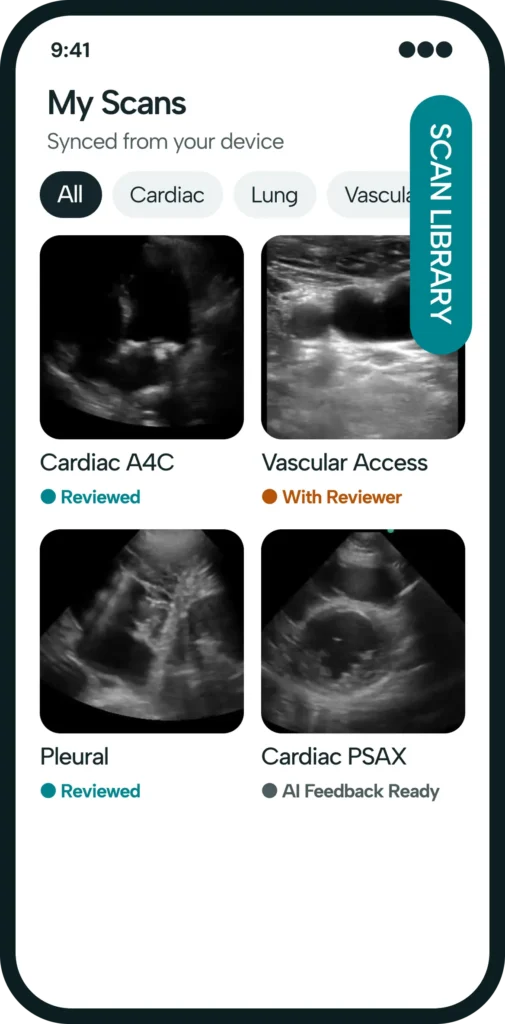
The GUSI app gives every scan feedback in minutes, routes the hard ones to expert reviewers, and tracks each clinician toward credentialing.
Looking for courses? Find training →
Who we are
Bringing POCUS beyond the bedside.
The Global Ultrasound Institute (GUSI) is a community of clinicians who teach point-of-care ultrasound and build the technology that makes it last.
We take clinicians from their first scan to full competency, then give them and their programs expert scan review, credentialing and the tools to keep every skill growing. We have trained 25,000+ learners in 140+ countries, work with 150+ residency programs, and have been the training partner behind POCUS programs from U.S. health systems to rural Kenya.
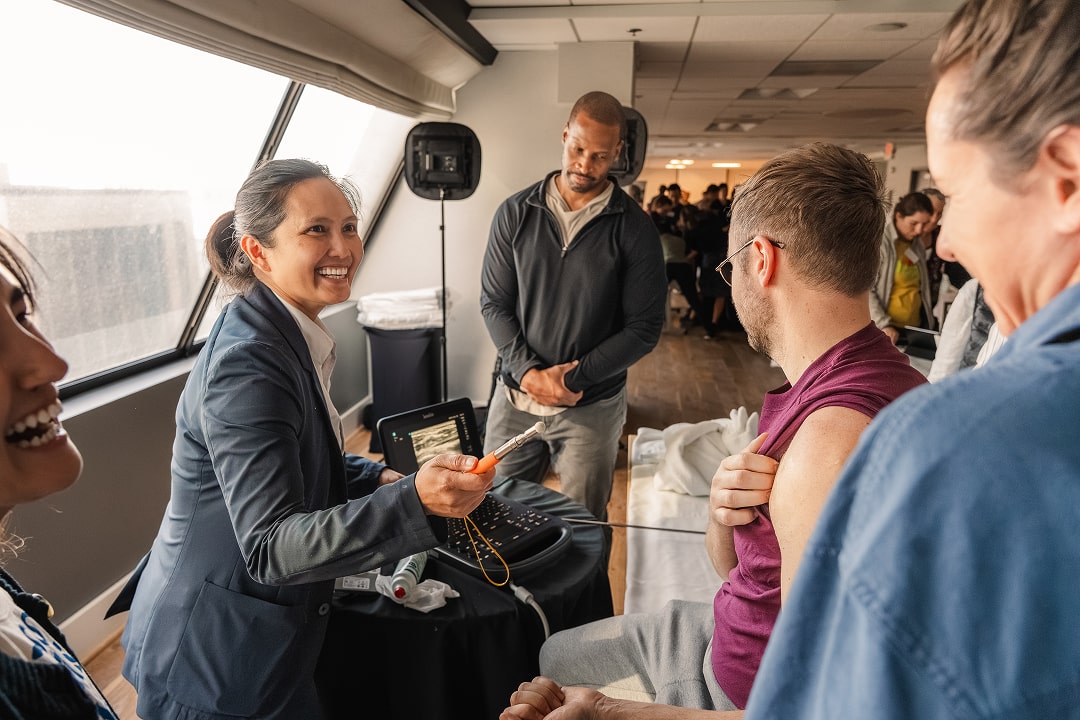
Clinical training
CME-accredited online courses, hands-on workshops and virtual fellowships, taught by practicing clinicians.
Expert scan review
Scan QA and Instant Review put expert feedback on every scan, so skills keep improving after the course.
Technology and innovation
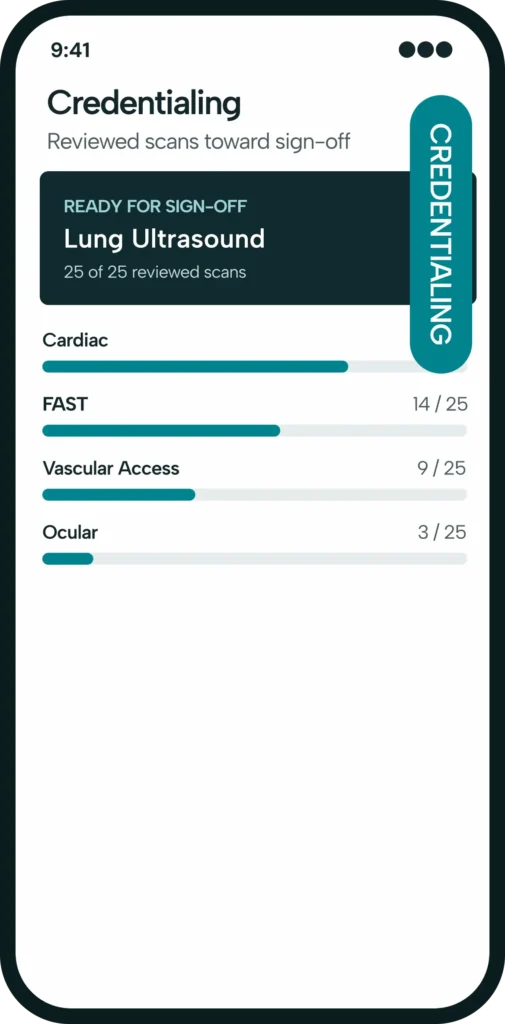
ScanHub archives every scan, routes it to review and tracks each clinician toward credentialing.
Care, wherever it’s needed
Every scan is for a patient on the other side of it. Our global health work takes POCUS to the places that need it most.
Trusted by
150+ residency programs, health systems and global health partners
How we help
Every scan someone learns to do well is a patient helped.
We help your program at every step after the course: every scan saved, reviewed by experts and counted toward each clinician’s credentialing, so skills keep growing and patients get answers sooner.
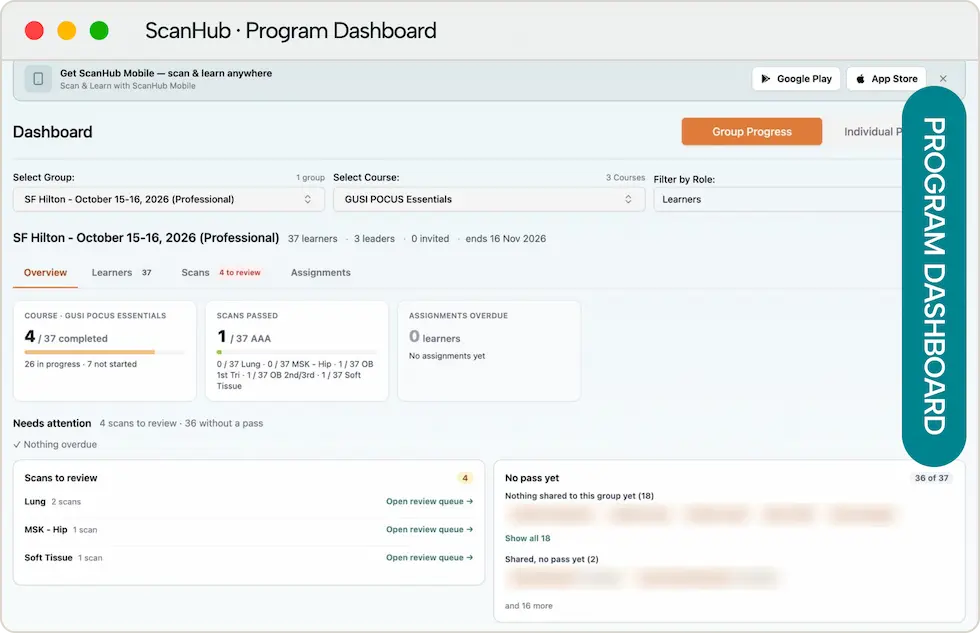
Program dashboard
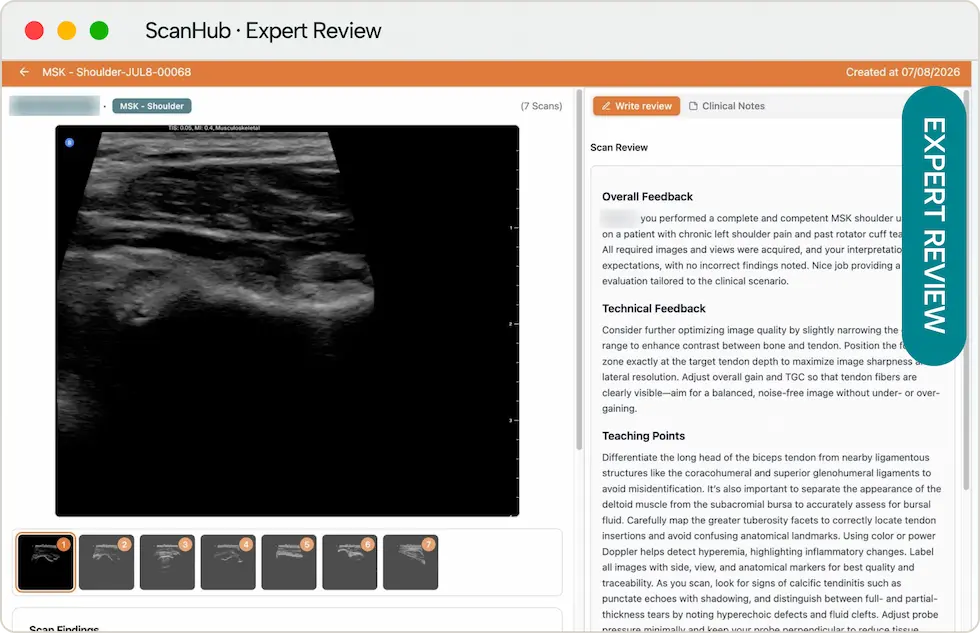
Expert review
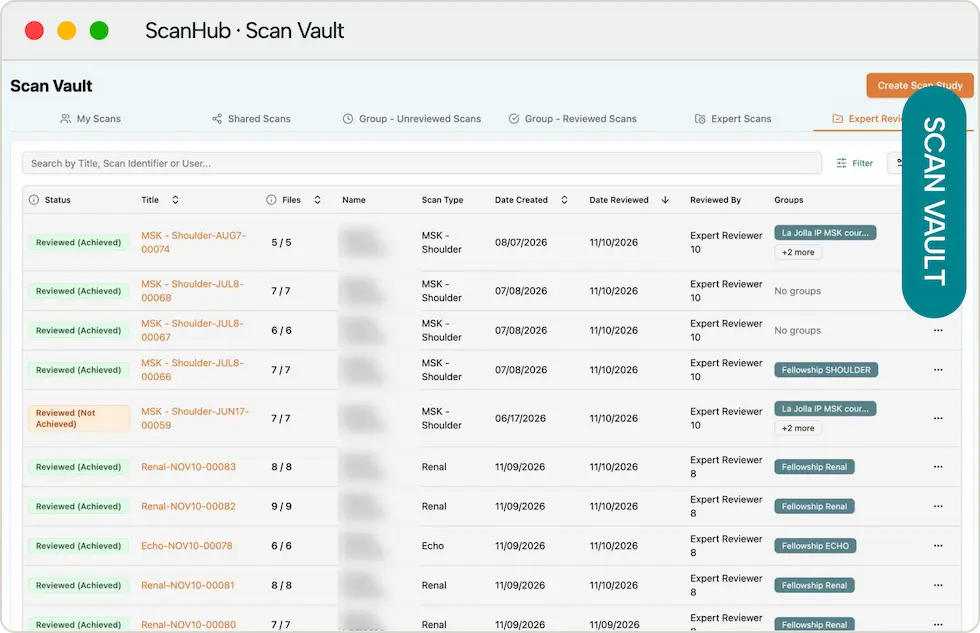
Scan Vault
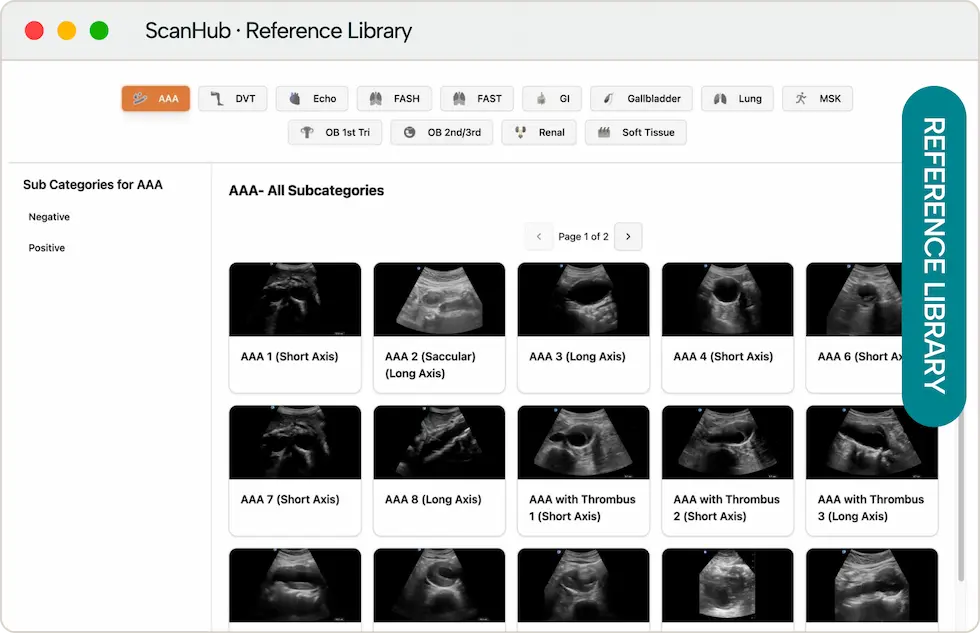
Reference library
AI FEEDBACK
Problem
Why it matters
Solution
SacnVault
Problem
Why it matters
Solution
EXPERT REVIEW
Problem
Why it matters
Solution
AI ASSISTANT
Problem
Why it matters
Solution
NEW
Scan QA · POCUS quality assurance
Every scan reviewed, without it taking over your faculty’s week.
Scan review is how you know a clinician is ready to scan on their own, and it’s the part of a program nobody has time for. Scan QA brings Scan Vault, Instant Review and reads from GUSI clinicians into one quality assurance process, with records you can credential from.
Reviewed · quality 4 of 5
Assumed scope
Curvilinear probe
Strengths
- Structure of interest centered in the field of view
- Depth set so the full structure is visible
- Calipers placed at clear borders for measurement
Weaknesses
- Structure of interest centered in the field of view
- Depth set so the full structure is visible
- Calipers placed at clear borders for measurement
Targeted recommendations
- Lower overall gain until the far field looks even
- Rotate the probe 90° and save a second, orthogonal view
How we Start
Consult
We get to know your learners, goals, sites and accreditation needs.
Pilot a cohort
Start with one group and see the difference for yourself.
Grow it together
Expand across years and sites, with the data to show it’s working.
Where is your program today?
building a program
We’re just getting started.
Set up curriculum, competency tracking, credentialing and
scan review the right way from day one, before QA becomes a pain point.
building a program
Scan review is eating our time.
Hand us part or all of the reads and give your faculty their time back, with feedback learners can use.
POCUS courses and training
Learn POCUS your way: online, in person or one-on-one.
Self-paced online POCUS courses with CME, hands-on in-person ultrasound workshops, and virtual POCUS fellowships with expert scan review, all taught by clinicians who scan every day.
Find POCUS training for your specialty:
Liver Essentials
Liver Essentials Course
Pediatric Essentials
Pediatric Essentials Course
Physical Therapy
Physical Therapy Essentials Course
Subscription Bundle:
Subscription Bundle: 3 Courses (POCUS + MSK + Pediatric Essentials)
Nursing Essentials
Nursing Essentials Course
POCUS E-Sim
POCUS E-Sim Complete
Musculoskeletal Essentials
Musculoskeletal Essentials Course
Obstetrics Essentials
Obstetrics Essentials Course
Point-of-Care Ultrasound
Point-of-Care Ultrasound Essentials Course
GUSI POCUS Essentials Virtual Fellowship
Liver POCUS Virtual Fellowship
OB POCUS Virtual Fellowship
Free POCUS resources
Keep learning between courses, on us.
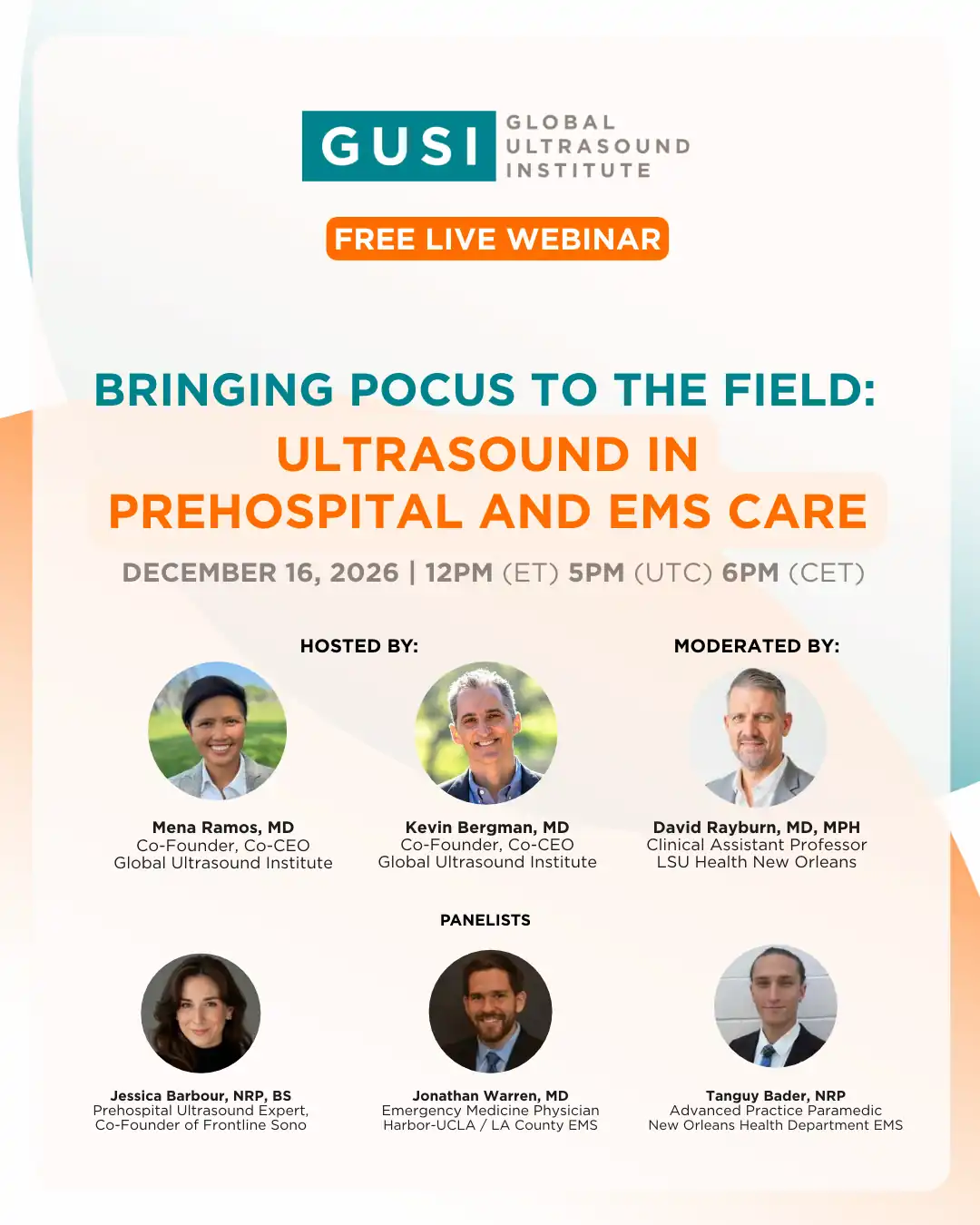
Free POCUS webinars
Join the conversation live
building a program
New on the blog



Learn With:
POCUSpedia
Look up any ultrasound term, from Morison’s pouch to TAPSE.
Practice with:
POCUS Pocket Guides
Quick-reference guides for scanning at the bedside.
Measure with:
Ejection Fraction Calculator
Estimate EF at the bedside in seconds.
Earn with:
POCUS ROI Calculator
See what POCUS could mean for your department.
Questions
What people ask us most
Does any patient information leave our hospital?
Protecting patient information is built into how ScanHub works. Scans are designed to be de-identified before they are sent for review, so reviewers see the image and the clinical question, not the patient. We walk your compliance and IT teams through exactly how it works, where scans are stored and who can see them before anything goes live.
How do scans get from our devices into ScanHub?
We’re making it as simple as a few taps. Learners can send scans from the ScanHub app today, and we’re building direct connections to the devices programs already use, including Butterfly, so scans land in their ScanHub library ready for feedback.
Does it work with our PACS, middleware and existing ultrasound machines?
ScanHub is being built to work alongside the machines, handhelds and archive you already have, including DICOM and non-DICOM scans. Tell us your setup on a consult and we’ll map how scans would flow from your devices to review.
How fast do learners get feedback?
Instant Review gives AI feedback on image quality within minutes of upload. Scans that need a closer look go to GUSI expert reviewers, who confirm or correct the read with structured feedback.
Can ScanHub support credentialing?
Yes. Every reviewed scan is tracked toward each clinician’s competency goals, so you have a documented record to share with your credentialing committee. Privileges are still granted by your institution; ScanHub gives you the evidence they ask for.
How do learners upload a scan?
From the ScanHub mobile app or a connected device. Learners pick the scan, tag the application, such as lung or cardiac, and send it for review. It lands in their Scan Vault straight away.
How do program directors see who is progressing?
The program dashboard shows every group you run: who is progressing, which scans are waiting for review and who has not passed yet. You can drill into any learner’s scans and feedback from there.
How does review work inside ScanHub?
Each scan gets AI feedback on image quality through Instant Review. Scans that need a closer look go to your faculty or GUSI reviewers, who give structured feedback on image quality, technique and interpretation.
Where can learners find reference images and answers between sessions?
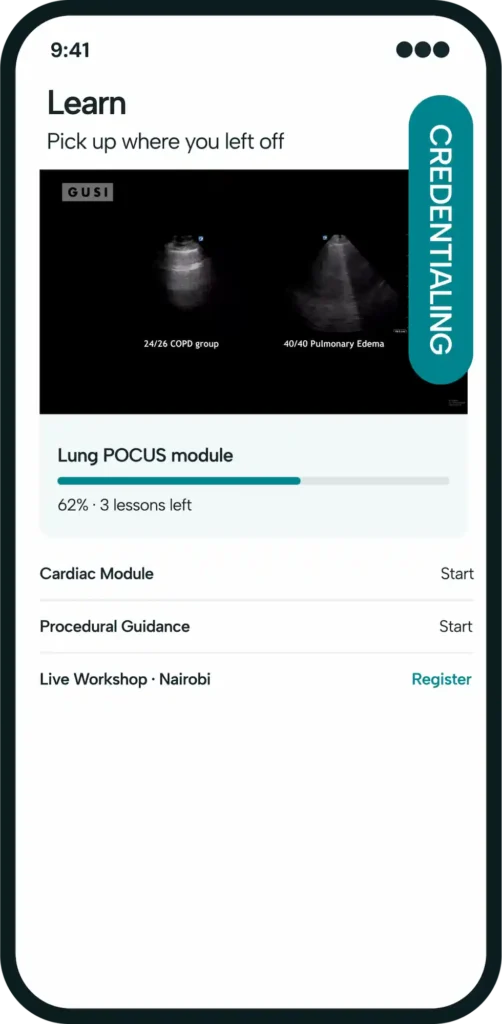
The reference library has labeled normal and abnormal loops for every application, from AAA to soft tissue. Sage AI, the built-in ultrasound assistant, answers learners’ questions any time.
Can learners keep and share their scan portfolio?
Yes. Every reviewed scan stays in the learner’s Scan Vault, searchable and tracked toward their competency goals, and they can share the portfolio with their program director or credentialing committee.
How is GUSI different from a weekend POCUS course?
A weekend course teaches the scan; it rarely gets a clinician to competency. GUSI pairs teaching with what happens after: learners keep scanning at work, upload their own scans and get expert feedback on each one until they can scan on their own.
How many scans does it take to become competent, and how do you track it?
Most institutions follow ACEP guidance and set a number of reviewed scans per application, commonly 25 to 50. ScanHub tracks each learner against the thresholds your program sets, application by application, so you always know who is close and who needs more practice.
Can we build GUSI training into our existing residency POCUS curriculum?
Yes. Programs use the online modules as the didactic component, then use ScanHub for scan logging, review and competency tracking during rotations. You keep your curriculum and your faculty; GUSI fills the gaps in content and review time.
Do you train nurses, PAs and therapists, or only physicians?
All of them. Alongside physician tracks, GUSI has dedicated Nursing and Physical Therapy Essentials courses, and our faculty teach mixed teams of physicians, NPs, PAs, nurses and therapists at in-person workshops.
What CME do learners earn, and does it count toward board requirements?
GUSI education is accredited for AMA PRA Category 1, AAFP and EACCME credit, for example 25 credits for POCUS Essentials. Learners should check with their own board for how credits apply to their maintenance of certification.
What happens at a GUSI in-person workshop?
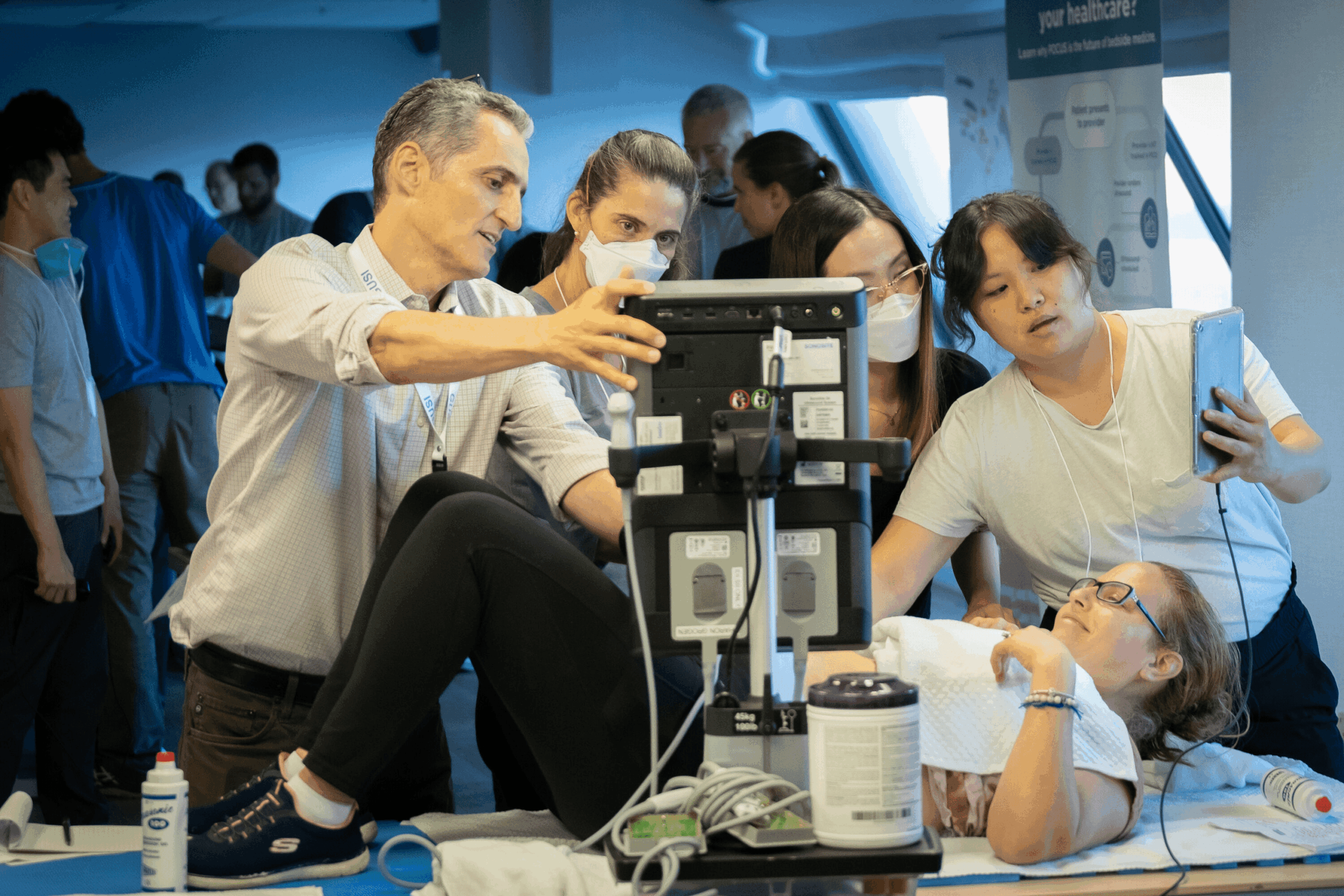
Most of the time is spent scanning. Learners rotate through stations on live models in small groups with GUSI faculty coaching at the machine, with short teaching sessions in between.
Who are the workshops for, and what level do I need?
Physicians, NPs, PAs, nurses and therapists, from first-time scanners to clinicians adding new applications. Each workshop lists its focus, such as OB, gynecology, cardiac, lung, FAST and vascular, or POCUS for anesthesia.
Where are workshops held?
Across the U.S., the U.K. and East Africa, including Nairobi, Kenya. The course calendar shows upcoming dates; full details and registration are on each workshop page.
Can we host a private workshop for our team?
Yes. GUSI brings faculty, devices and curriculum to your hospital, residency or conference and tailors the stations to your specialty. Host a GUSI workshop.
What happens after the workshop?
Skills fade without practice. Learners can keep scanning at work, upload their scans to ScanHub and get expert feedback, so the workshop is the start of competency rather than the end of it.
We already have POCUS faculty. Why would we hand off scan review?
You don’t have to hand it all off. Scan QA lets you choose: your faculty, GUSI clinicians or both read against the same standard. Most programs use it to clear the backlog and keep feedback fast while faculty keep oversight.
Can POCUS actually generate revenue for our department?
Often, yes. Many bedside scans are performed but never billed because the images or interpretation were not saved. ScanHub archives every scan with its review, giving you the documentation billing requires. The POCUS ROI calculator estimates what that could mean for your program.
How is pricing structured?
Pricing depends on how many learners and sites you have and how much of the scan review you want GUSI to take on. Book a consult and we will put together a proposal for your program, including a pilot option.
What does our IT team need to do?
Our team leads setup. Your IT and compliance teams review how scans will be sent and de-identified, and sign off before launch. We provide the documentation they need for that review.
What results can we show leadership after a pilot?
A pilot with one cohort gives you hard numbers: scans performed and reviewed, time to feedback, each learner’s progress toward competency, documentation rates and faculty hours saved. That becomes the case for expanding across years and sites.
For programs and health systems
Ready to build a POCUS program that lasts? Let’s grow it together.
Tell us about your learners, sites and goals. We’ll show you how GUSI can train, review and track every scan in your program.