
Point-of-care ultrasound is a hands-on skill. Online lessons can teach anatomy, indications, image examples, and scanning principles, but clinicians still need time with a probe in hand to learn how small changes in position, angle, depth, gain, and pressure affect the image.
That is the role of GUSI’s in-person POCUS training for Primary Care primary care in San Francisco: combine focused pre-course learning with live scanning, small-group coaching, clinical cases, and structured feedback so family physicians, internists, urgent care clinicians, and advanced practice providers can practice the skills they plan to use in everyday care.
Next San Francisco POCUS Course
October 15-16, 2026 | Hilton San Francisco Financial District. The current two-day course offers 13.5 CME credits in person plus access to the 25-CME POCUS Essentials online course, for 38.5 CME credits available in total. Registration and current pricing are available on the GUSI POCUS for Primary Care course page.
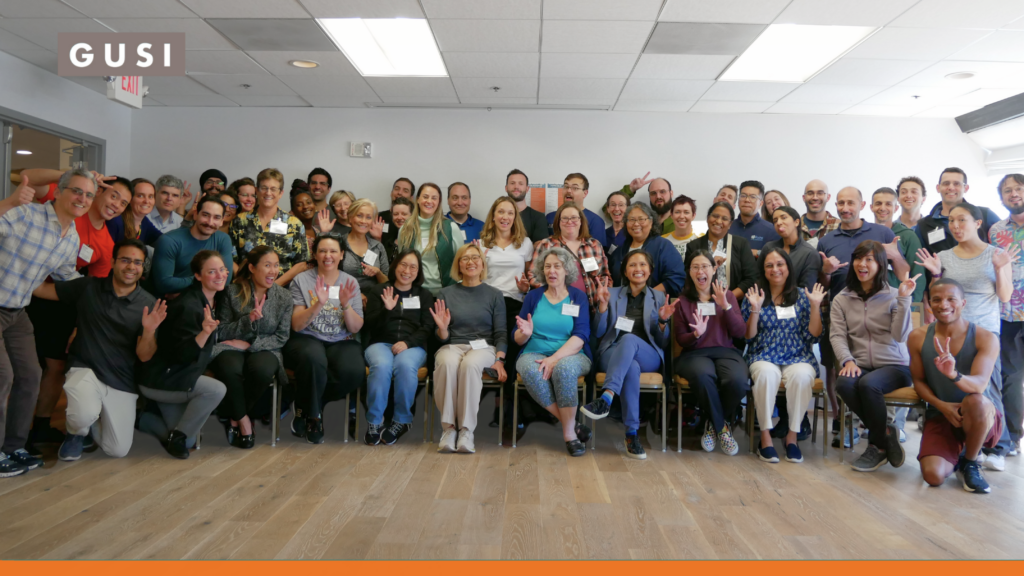
This article also looks back at GUSI’s April 2025 San Francisco course, where learners rotated through hands-on stations, received individualized faculty coaching, and finished with an OSCE-style skills session. The format offers a useful look at what immersive POCUS education can feel like, while the exact October 2026 curriculum should be confirmed on the current course page as it is finalized.
What Does Hands-On POCUS Training for Primary Care Look Like?
Good hands-on training is more than watching an instructor demonstrate a view. Learners need repeated opportunities to acquire the image themselves, make mistakes, adjust technique, explain what they are seeing, and connect the finding to a clinical question.
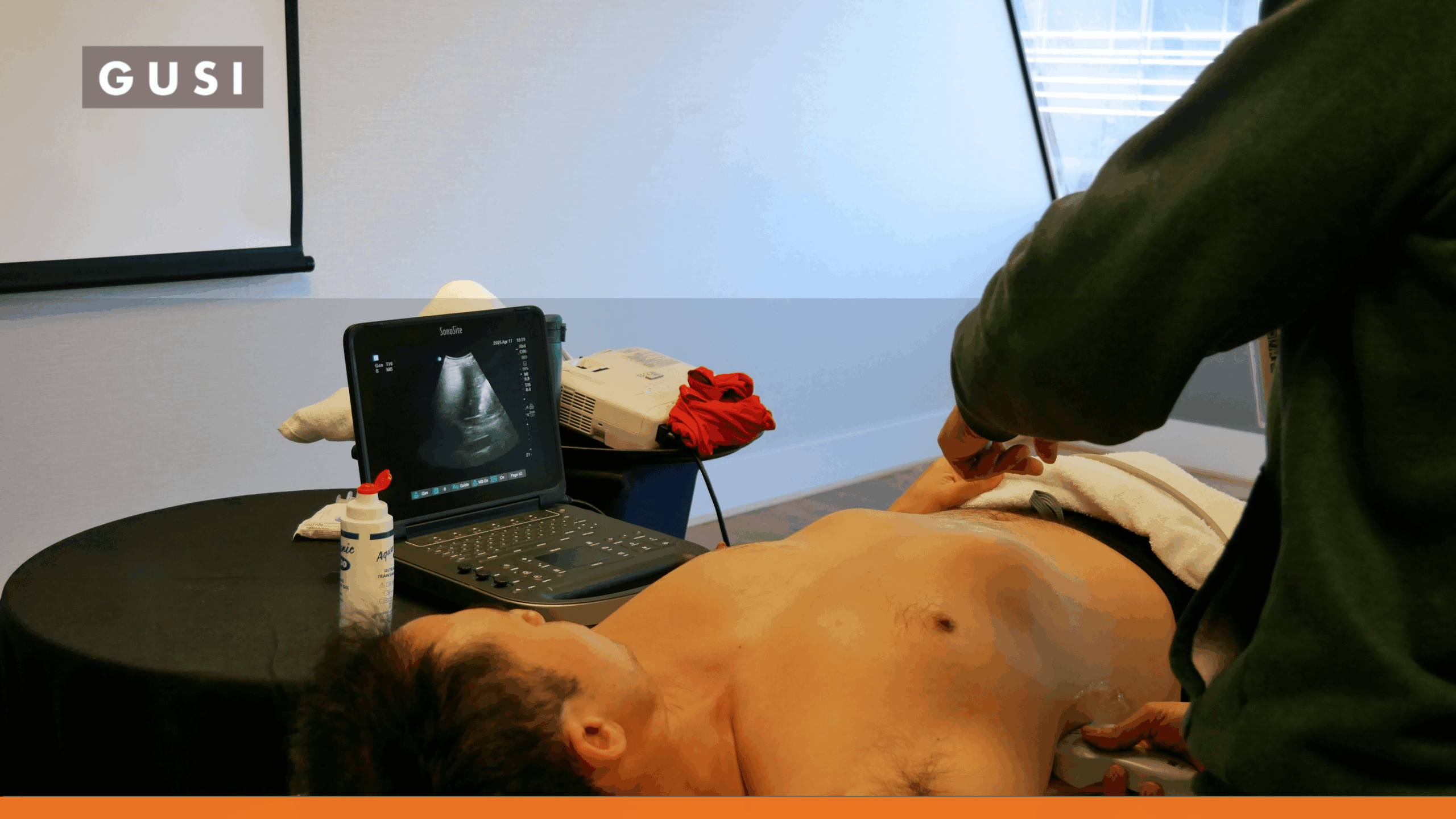
In GUSI’s San Francisco format, learners work in small groups with live models and training equipment while faculty provide immediate coaching. The course page describes a flipped-classroom model, which moves foundational learning into the included POCUS Essentials course so more in-person time can be devoted to scanning.
| Training Component | What the Learner Practices |
|---|---|
| Pre-course learning | Ultrasound basics, anatomy, indications, limitations, and image examples before live scanning. |
| Faculty demonstration | Probe position, orientation, landmarks, common mistakes, and clinical context. |
| Hands-on scanning | Image acquisition, optimization, probe movement, and anatomy recognition. |
| Real-time feedback | Immediate correction of technique rather than practicing an error repeatedly. |
| Clinical cases | Connecting images to a focused question and an appropriate next step. |
| Skills assessment | Demonstrating technique and reasoning in a structured scenario. |
| Post-course practice | Continuing scans, feedback, review, and competency development after the workshop. |
Why Hands-On Practice Matters
Family medicine POCUS education is increasingly moving towards a structured, competency-based training. In July 2026, a Society of Teachers of Family Medicine (STFM) task force published a national Delphi study to help define which POCUS applications should be prioritized in the US family medicine residency training programs. STFM also provides dedicated family medicine POCUS teaching modules and faculty-development programs that combine workshops, image review, mentorship, and skills assessment. [1][2]
Longitudinal family medicine programs point in the same direction. A 2026 report describing a decade of residency POCUS education used asynchronous modules, simulation, supervised scanning, standardized patients, sonographers, faculty preceptors, and structured image review rather than relying on a single teaching format. [3]
For practicing primary care clinicians, the implication is straightforward: an intensive in-person course can accelerate the early learning curve, but confidence and competence still develop through continued scanning and feedback.
What Learners Practiced in the 2025 San Francisco Course
The April 2025 San Francisco course covered a broad set of primary care applications. This list describes that completed course and should not be treated as the final October 2026 agenda until the current curriculum is published.
| Application Area | 2025 Training Focus | Clinical Framing |
|---|---|---|
| Cardiac | Focused cardiac views and assessment of gross function / volume-related findings | Focused bedside assessment, not comprehensive echocardiography. |
| Lung | Lung sliding, B-lines, pleural fluid, consolidation patterns, and pneumothorax-related signs | Findings are interpreted in clinical context and do not replace definitive testing when needed. |
| Aorta / abdomen | Aortic, FAST-style, and focused abdominal views | Useful for defined questions; comprehensive imaging may still be required. |
| Renal / bladder | Hydronephrosis and bladder assessment | A focused scan does not rule out all causes of urinary or flank symptoms. |
| Gallbladder | Gallstones and selected sonographic features of biliary disease | Equivocal or discordant findings require further evaluation. |
| MSK / soft tissue | Selected superficial anatomy and common primary care applications | Application-specific training is essential. |
| Basic obstetric scanning | Selected early-pregnancy or focused obstetric views | Must remain within clinician scope, local policy, and appropriate referral pathways. |
| Procedures | Selected ultrasound-guided procedures such as vascular access or joint-related interventions | Requires procedural training, anatomy recognition, and supervision appropriate to the intervention. |
Small Groups and Real-Time Faculty Feedback
The value of a low-ratio course is that faculty can see what the learner is actually doing. Probe grip, wrist position, orientation, pressure, patient positioning, and image optimization are difficult to correct from a lecture hall.
The 2025 course participants repeatedly highlighted the usefulness of faculty coaching. One family medicine attendee specifically praised instructor Bruno Vargas’s practical advice and teaching style. Another returning GUSI learner described the course as efficient, informative, and worth coming back for.
That kind of feedback is especially important for beginners, who may be able to recognize a textbook image before they can reliably acquire it on a real patient.
OSCE-Style Assessment: Turning Scanning Into Clinical Decisions
The 2025 San Francisco course finished with an Objective Structured Clinical Examination (OSCE)-style session. Learners were asked to apply scanning skills in a clinical scenario rather than simply reproduce a memorized view.
A geriatric medicine participant highlighted the amount of scanning time and described the OSCE as “super fun.” The educational value is more important than the label: structured assessment helps learners discover whether they can acquire an image, recognize what they are seeing, and use the result appropriately when the pressure is slightly higher than at a practice station.
A course assessment is still not the same as institutional credentialing or independent competency for every application. It is a checkpoint that can help the learner and instructor identify what is ready to use, what needs more practice, and where supervision or formal review remains important.
What Primary Care Learners Say About GUSI Training
The current GUSI Primary Care course page features feedback from family medicine clinicians across different practice settings. The recurring themes are clinical relevance, approachable instructors, and teaching designed for busy primary care practice.
| Learner | Background | Published Feedback Theme |
|---|---|---|
| Cindy Yang, MD, FAAFP | Family Medicine Residency / Sports Medicine Fellowship | Described the workshop as clinically oriented and praised the patience and engagement of the instructors. |
| Billy Ligon, MD | Medical Director of POCUS, Department of Family Medicine | Said GUSI’s teaching approach was relevant and effective for the busy primary care provider. |
| David Johnson, MD | Family Medicine | Emphasized the value of integrating POCUS into primary care for faster bedside decision-making and patient communication. |
| Gayatri Khanna, MD | Geriatric Medicine | Highlighted the amount of hands-on scanning and enjoyed the OSCE-style session in the 2025 San Francisco course. |
Who Should Attend a Primary Care POCUS Course?
The course is designed for clinicians who want practical ultrasound skills that fit generalist care. That can include family physicians, internists, urgent care clinicians, residents, fellows, physician assistants, nurse practitioners, and other qualified clinicians whose scope includes the applications being taught.
Beginners can use the course to build foundational scanning techniques. More experienced learners may use faculty time to correct persistent image-acquisition problems, improve efficiency, expand selected applications, or strengthen teaching skills.
The course is not meant to bypass local credentialing, scope-of-practice rules, comprehensive imaging, or specialist consultation. Learners should plan how they will continue scanning and receive feedback after the event.
What to Expect From the October 2026 San Francisco Course
Time-Sensitive Registration Note
As of August 11, 2026, the live course page lists early-bird registration through August 31, 2026, at San Francisco local time. Treat this as a removable promotional block in WordPress so the evergreen article does not carry an expired offer after the deadline.
What Happens After a Two-Day POCUS Course? The best next step after an intensive course is not to wait until the next workshop. It is to scan regularly within your scope, save representative studies when appropriate, review your own images, and get feedback on difficult or borderline scans.GUSI’s current learning pathway allows learners to continue through the included POCUS Essentials course, expert Ultrasound Scan Reviews, and the POCUS Essentials Virtual Fellowship. Those options serve different needs, but the principle is the same: skill development is longitudinal.
Ready for Hands-On POCUS Training in San Francisco?
The next GUSI POCUS for Primary Care course is scheduled for October 15-16, 2026, in San Francisco. Review the current course page for registration, pricing, CME details, hotel information, and the finalized curriculum as it becomes available.
| Detail | October 2026 Course |
|---|---|
| Dates | October 15-16, 2026 |
| Venue | Hilton San Francisco Financial District |
| Format | Two-day in-person course using a flipped-classroom model and hands-on scanning |
| In-Person CME | 13.5 CME credits |
| Included Online Learning | POCUS Essentials, 25 CME credits |
| Total CME Available | 38.5 CME credits |
| Learning Environment | Low instructor-to-learner and learner-to-ultrasound ratios designed to maximize scanning time |
| Current Curriculum | The product page states the detailed 2026 curriculum will be posted as finalized |
| Registration | Current pricing, career-stage options, and availability are maintained on the live course page |
| After the Course | Best Next Step |
| Need to reinforce concepts | Continue the included POCUS Essentials modules and revisit relevant lessons. |
| Need feedback on image acquisition | Submit scans for structured expert review where appropriate. |
| Need repeated mentorship | Consider a longitudinal fellowship or mentorship pathway. |
| Implementing POCUS in a clinic or residency | Use the Family Medicine training hub and institutional workshop/program resources. |
| Unsure whether a scan is sufficient clinically | Follow local protocol and escalate to formal imaging or specialist evaluation when needed. |